

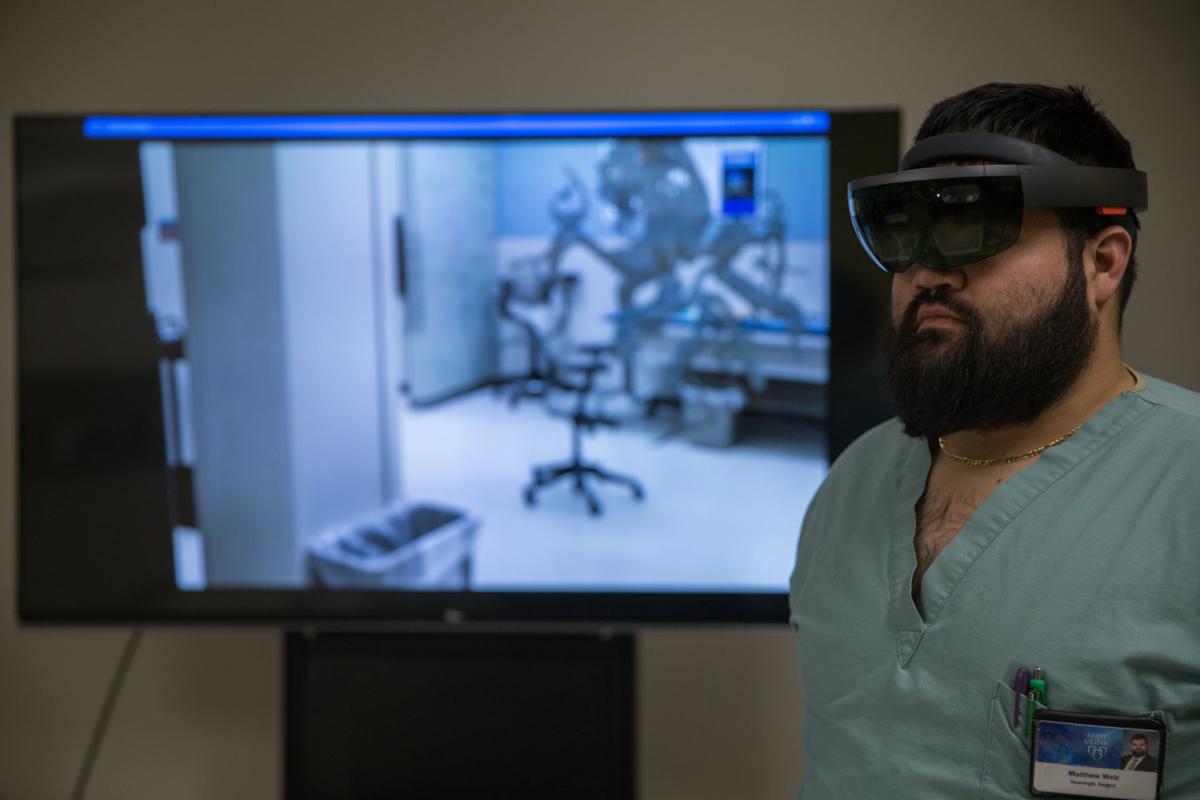
PHOENIX 鈥� Imagine you鈥檝e just been diagnosed with a malignant brain tumor and need surgery. Instead of looking at shadowy black and white 2-D images you can鈥檛 decipher, you put on goggles and 鈥渨alk through鈥� the cancer using augmented reality.
As a result, you can better grasp your disease, said Dr. Matthew Welz, a neurological surgeon at Mayo Clinic Arizona.
鈥淭hey feel a lot more comfortable going into surgery with this,鈥� Welz said of patients.
The Precision Neurotherapeutics Lab at the clinic in Phoenix is using technology similar to 鈥淧ok茅mon Go鈥� to ease patient concerns about brain surgery and help doctors find the safest and least invasive route for surgery and treatment.
Models from the lab and 3-D simulations create a 360-degree view of the brain, using special goggles, to provide patients with in-depth look at tumors or other abnormalities. It helps them better understand their conditions and possible treatment plans.
People are also reading…
Welz said the lab hopes to eventually use the goggles to explain conditions and treatment options to all patients but, for now, limited resources allow only the patients requiring the most critical or complicated procedures to be shown the simulation.
The simulations also predict tumor activity for specific patients, helping health-care professionals plan for the best routes of treatment, whether it be radiation, surgery or chemotherapy, said Kristin Swanson, co-director of Mayo鈥檚 Mathematical Neuro-Oncology Lab, which is part of the Precision lab.
The lab also uses augmented reality to tailor treatment strategies for other conditions, such as scoliosis. 3-D simulations of the spinal column allow surgeons to view overactive curvatures and avoid complications arising from bolts inserted during previous surgeries to straighten the spine.
The simulations help surgeons 鈥渄o the operation before the operation鈥� to reduce harm while minimizing invasiveness, according to Dr. Bernard Bendok, chair of neurosurgery. He said 3-D imaging displays layers of the brain that 2-D imaging hides, which helps surgeons better differentiate between healthy and cancerous cells.
鈥淲hat augmented reality is is the ability through special cameras to superimpose that so that I am actually looking at the real brain. Much like the Pok茅mon game, I can see additional things layered on top,鈥� Bendok said.
The images, seen through special goggles, show doctors 鈥済radients鈥� of cancerous cells, which allow radiation treatment to target cells in different areas at different intensities, without harming functioning cells.
The lab provides more than just augmented reality. Staffers, led by Swanson, are using high-level math to change the way doctors are thinking about treatment.
Swanson, who earned a doctorate in mathematical biology, started the Mathematical Neuro-Oncology Lab at the clinic about three years ago. She is co-director with Bendok, combining their different specialties: 鈥淚t鈥檚 very personalized medicine meets math.鈥�
She instilled her passion for unique patient care when her father and two brothers died of the same form of cancer.


