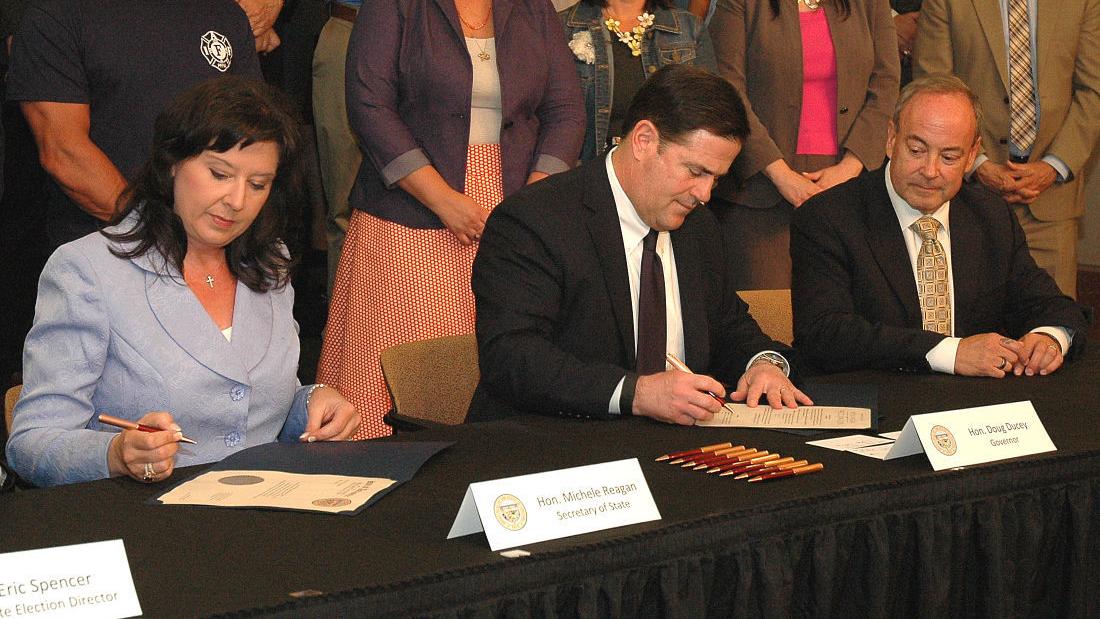
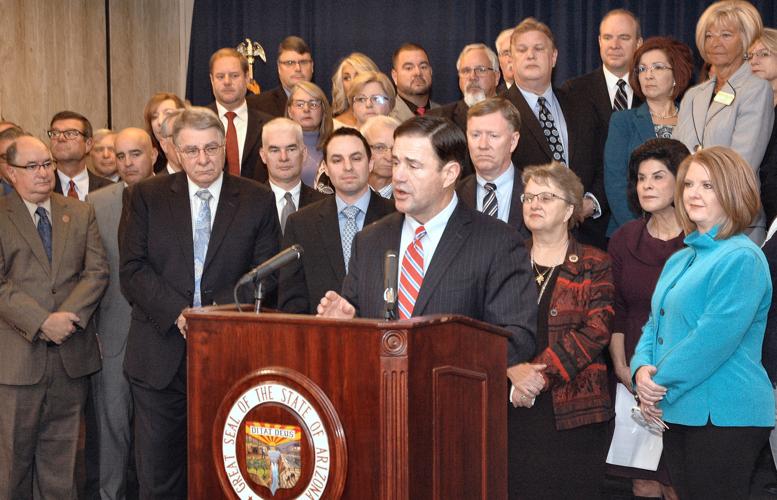
PHOENIX 鈥� Gov. Doug Ducey says he won鈥檛 meet with the leaders of two teacher groups to talk about salaries and related issues even as they take the first steps toward a walkout.
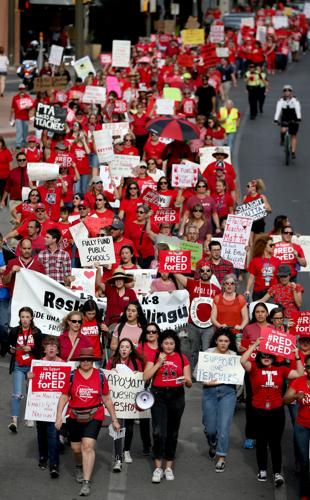
The governor鈥檚 statement comes less than a week after a request by Noah Karvelis of Arizona Educators United and Joe Thomas of the Arizona Education Association 鈥渢o begin a negotiation process to resolve the #RedForEd demands.鈥� Those include not just a 20 percent salary increase to compete with neighboring states, but also restoring education funding levels to where they were a decade ago.
It also comes as Arizona Educators United is working with its member teachers to set a date for a walkout to get the attention of Ducey and legislators and to show the teachers are serious.
鈥淲e鈥檙e meeting with the decision-makers鈥� instead, the Republican governor said, meaning school superintendents and other officials. 鈥淎nd we鈥檙e going to continue to meet with the decision-makers.鈥�
People are also reading…
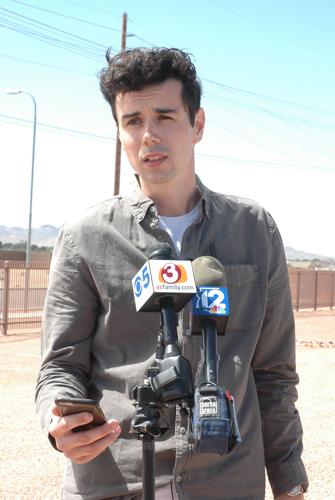
Karvelis said the decision is disappointing but not entirely a surprise.
鈥淲e feared that,鈥� he said. 鈥淲e hoped that wasn鈥檛 true. We thought maybe he would come to the table on this. But he鈥檚 continuing to ignore us.鈥�
Meanwhile, Ducey is sticking with his plan to give teachers a 1 percent pay raise this coming year on top of a 1 percent increase for the current school year.
Ducey鈥檚 position could have implications, and soon.
Karvelis said Tuesday that his newly formed group is 鈥渁bout to hit the numbers we are looking for鈥� in terms of job actions. Those include walk-ins, where teachers remain outside until the start of the day and enter together to show solidarity, as well as actual walkouts, where they simply do not show up to school.
鈥淲e will be taking escalated action and plan to set a date shortly if we do not see any response from him,鈥� Karvelis said.
Ducey said late Tuesday that he doesn鈥檛 want a strike.
鈥淲e would love to avoid a walkout,鈥� he said. 鈥淲e want our teachers inside the classroom teaching, we want our kids learning, and we want more dollars in their paycheck.鈥�
But the governor also said he does not have a plan for what he intends to do if thousands of teachers call in sick.
Instead, he鈥檚 trying to get his spending plan approved by the Legislature.
鈥淭he idea right now is we want to move the budget forward so we can get these dollars to them,鈥� Ducey said.
He also suggested that teachers are unhappy because they don鈥檛 understand what he鈥檚 already done for them and what he鈥檚 prepared to do in the future. And he said it鈥檚 wrong to say his plan is simply that 1 percent pay raise.
For example, he said the state has added 9 percent in funds that are available for teacher pay since 2015.
More than half of that, however, is for new teachers necessary just to stay even with student growth.
There鈥檚 also the $1.7 billion cumulatively that Ducey said has been added to K-12 funding since he took office in 2015.
But here, too, that reflects money the state is required to add simply to keep pace with inflation and student growth. It also includes more than $300 million a year the state is providing to make up for money illegally taken from schools in the first place, in violation of state law requiring annual inflation adjustments.
He also disputes that teacher pay in Arizona is as bad as some have suggested, contending that the rankings are misleading. Ducey has said Arizona is no worse than No. 43 nationally.
But Dan Hunting, senior policy analyst of the Morrison Institute for Public Policy at Arizona State University, said for 2017, elementary school teachers rank 49th in the nation, up one notch from 2016, when the cost of living is factored in. There also was a one-spot increase for high school teachers, to 48th, Hunting said. The Morrison Institute 鈥渦ses nonpartisan research, analysis and public outreach to help improve the state鈥檚 quality of life,鈥� its website says.
Ducey said a lot of the furor among teachers is being stirred up by some who are more interested in making waves than actually dealing with the issue.
Exhibit No. 1 for Ducey is the AEA鈥檚 Thomas, who used a #RedForEd event to endorse Democrat David Garcia for governor to run against Ducey in November.
Also, Karvelis is running the campaign of Kathy Hoffman, a Democratic candidate for state superintendent of public instruction.
鈥淲hy would I want to sit down with someone who wants to play politics?鈥� Ducey asked.
While many teachers find the governor鈥檚 plan wanting, Ducey said the package has the backing of more than two-dozen school superintendents. These are the officials who turned out for a January news conference when Ducey agreed to restore $100 million the state had shorted schools in what it was supposed to provide for things like textbooks, computers and buses.
That is less than Ducey himself cut from the same account in his first year in office. But the governor said he is committed to restoring the full funding of $371 million during the next five years.
It is that work with the superintendents that the governor said has been his focus, rather than with the teacher groups.
Ducey said he believes that any new money for those expenses should free up dollars that schools can then use for salary increases.
Karvelis derided that suggestion.
鈥淲e don鈥檛 have paper towels. We don鈥檛 have new textbooks. We don鈥檛 have tires for the bus,鈥� he said. 鈥淪o to think that there鈥檚 some sort of extra money here or that him giving more money to capital is going to open up all these different opportunities to increase our teacher wages is ridiculous.鈥�
Tim Ogle, executive director of the Arizona School Boards Association, said any money helps 鈥� up to a point.
鈥淕estures like that are a step in the right direction,鈥� he said. 鈥淏ut that doesn鈥檛 solve the problem.鈥�
The bottom line, Ogle said, is that Arizona has a 鈥渃risis鈥� in attracting and retaining teachers.
As to the potential walkout, while Ducey has no specific contingency plan, school officials are taking the threat seriously.
Ogle said his organization scheduled a 鈥渨ebinar鈥� for school officials on how to handle both walk-ins and walkouts. That includes dealing with the remaining staff workers on site, as well as the needs of parents.
The list of what #RedForEd wants also includes a demand that the state not approve additional tax cuts until teacher pay in Arizona reaches the national average. Ducey has rebuffed that, too, and is promoting his own proposal to cut state income taxes owed on military pensions, a change that eventually will reduce revenues by $15 million a year.
Ducey said his budget plan should be adopted. 鈥淚鈥檓 on the teachers鈥� side,鈥� he said, saying he wants to see they get more money in their paychecks. 鈥淭his is the best and quickest way to get it there.鈥�
The problem of teacher pay is not specifically of Ducey鈥檚 making.
He came into office on the tail end of the Great Recession in which lawmakers, looking for ways to balance the budget even as they approved tax cuts, made major slices in state funding, with K-12 education taking a huge hit.
In the 2007-2008 school year, the state provided $4,959 in per-student funding. That dropped as low as $3,814 by the 2011-2012 school year, according to legislative budget analysts.
When Ducey took office, the figure was $4,154. It now is $4,720.
To restore state funding to pre-recession levels, it would take more than getting Arizona back to $4,959 per student: With inflation, that figure is now worth less than $4,200.

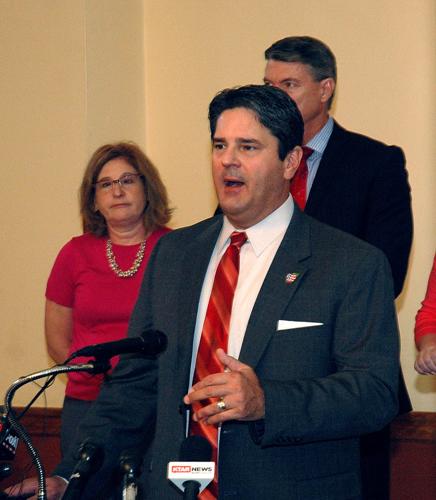
Joe Thomas of the Arizona Education Association
On Twitter: @azcapmedia