




Atlas, according to Greek mythology, was a Titan, a giant with incredible strength who was condemned by Zeus to carry the world on his shoulders for eternity.
When the Marist College was built in 1915, at 72 W. Ochoa St. at South Church Avenue in downtown Tucson, the builders saw fit to place two Atlas figures on the north-side entrance under the balcony of the two-story adobe structure. It鈥檚 a good thing they did.
It could be that the building, if not literally then at least metaphorically, has been resting on their shoulders for years. Most notably was when the building鈥檚 northwest corner was laid open like a gaping wound.
Vacant for more than a decade, coveted by developers for years and the home of countless generations of pigeons, it may be the city鈥檚 most beloved and cherished structure.
It has also been an eyesore.
People are also reading…
It is now undergoing a new phase as the Phoenix-based Foundation for Senior Living converts it into an affordable senior-living facility with eight units and a community center. Renovation of the College is expected to cost $2.8 million.
It is part of a $22 million project in which an additional 75 apartments are also under construction on the site of the former Bishop Manuel D. Moreno Pastoral Center, at 111 S. Church Ave. Together they are to be called The Marist at Cathedral Square.
During the renovation, under local contractor Tofel Construction, the day-to-day operations now rest on the shoulders of another pair: Dave Watts, the superintendent, and Louis Stroble, the project manager and superintendent.
The building is really important to Tucsonans, Watts said. 鈥淚鈥檝e got people driving up all the time, stopping their cars and saying, 鈥楩inally, somebody is doing something to this building,鈥欌�� he said.
Bringing a crumbling adobe structure into the 21st century by next summer could be quite the challenge 鈥� but Watts and Stroble are ready for it.
鈥淚 love the challenge, I鈥檝e worked on a lot of projects in my life and this is interesting,鈥� Stroble said.
To begin with, the building has undergone a significant structural transformation. It has been changed from a mostly adobe building to having a steel moment frame inside the structure that supports the whole building, Stroble said.
A steel moment frame is like a steel skeleton inside the existing building. It now has eight steel columns with 24 crossbeams that are connected, he said.
鈥淕etting the steel in place was the most challenging component of the project. That was the part that made me nervous,鈥� said Jim Tofel, a vice president with Tofel Construction, which started here in 1984.
Watts and Stroble both spent a lot of time working with local sub-contractor J.B. Steel to develop a steel-installation plan.
The vertical steel beams had to be lowered through holes in the ceiling. Then, once they were anchored, the horizontal beams were slipped into place by cutting holes in the side of the building.
鈥淭hose days were insane,鈥� Watts said of the installation. It was, he said, his worst week of the project to date.
Stroble saw it differently, saying it was the best part. 鈥淭hey had them in at the end of that first week,鈥� he said.
Even so, in some places the steel is next to the wall like it was designed that way, Stroble said, but at another point the wall is off by as much as 3 inches.
Shimming, using material to fill the gaps, was needed to make the steel rest against the walls.
The building is pretty square, but the walls are not level and neither is the floor, Watts said. 鈥淎ll the steel is level, but the building wasn鈥檛, so we had to fix it.鈥�
Tofel added, 鈥淚t鈥檚 basically a steel building now with an adobe veneer.鈥�
Steel bands, one on the inside and one on the outside are sandwiched together and will hold the adobe together, Tofel said. Then exterior plaster will go over the steel so it will not be visible, 鈥渟o it looks like it鈥檚 still an adobe building.鈥�
鈥淭his is not your run-of-the-mill type of project,鈥� Tofel said. 鈥淔rom a personal perspective, I really like the challenge of the project.鈥�
As far as subcontractors on the project are concerned, Watts and Stroble have relied on several local businesses such as Tellez Masonry, Oden Construction, Escalante Concrete, Southwest Hazard Control and J.B. Steel.
There鈥檚 a lot of coordination among the subs, Stroble said, so they got the ones they were comfortable with. He and Watts continuously sit and brainstorm, figuring out each procedure, minimizing problems and maximizing how they are going to use the other companies. 鈥淲e figure out what鈥檚 the best way and away we go,鈥� Stroble said.
鈥淲e were very careful in terms with our subcontractor selection and making sure we had the right guys on his project,鈥� Tofel said.
Tellez is doing the plaster and Oden is working on the windows. Tofel said that鈥檚 important, because, 鈥淭he plaster and the windows, that鈥檚 what everyone is going to see from the outside.鈥�
The process of asbestos and lead removal took Southwest Hazard four months to complete, Watts said.
鈥淚 couldn鈥檛 have asked for more with those guys,鈥� he said. 鈥淭hey had 12-15 guys a day most of the time.鈥�
Stroble noted they used diamond bits to grind the asbestos off the Atlas figures.
鈥淭hey had these pencil grinders that they used to grind them so as not to destroy the beards and hair.鈥�
Watts even 鈥渟uited up鈥� with protective clothing to watch the process, because he wanted to know what their tools were doing to the figures.
At one point, a beehive weighing between 50 and 100 pounds was removed from one of the old chimneys, Stroble said. There were fireplaces in the building that were removed, but the chimneys were still in place. Once they were removed, it took a couple of days before all the bees left.
In addition to working constantly with the subcontractors, Watts and Stroble also meet every two weeks with the owners, he said.
鈥淭he owners seem satisfied with what we are doing and they like the progress. They like what they see.鈥�
Stroble added, 鈥淭he city is going to love it when we are finished because right now we鈥檙e a sore spot and once we鈥檙e finished and gone, it鈥檚 going to be really nice.鈥�
He can tell by the feel
As far as dirt goes, not just any dirt will do for Brian Tellez of Tellez Masonry. It鈥檚 got to be the good stuff.
What he looks for is the right combination of clay, silt and sand, but not necessarily in equal portions, he said. These ingredients, plus some straw, are essential to making good, solid adobe bricks, he said.
鈥淚 look for material from different places and usually look for clean soil,鈥� Tellez said.
He has been doing it for so long now that he can tell by the feel.
On occasion his workers will use grass or other fiber, including some horse manure, 鈥渏ust to put it to the mix.鈥�
And he should know, because Tellez comes from a line of masons and cowboys starting with his grandfather, who established Edward Tellez and Sons Masonry in the 1970s, he said.
鈥淢y grandfather, my father, my great uncles were all masons and cowboys,鈥� Tellez said.
He has been in the masonry trade for 22 years, not counting the years he was in culinary school and the 10 years he was a chef.
The methods he uses seem to work because he is contacted regularly for historic adobe projects around town, usually for downtown restoration projects, he said.
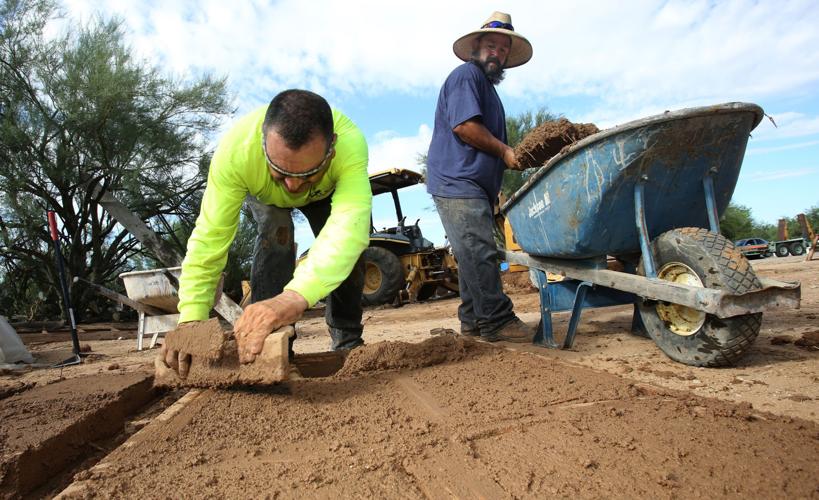
His crews make adobe in a somewhat traditional manner. Instead of mixing the mud by hand or by using their feet, they have a backhoe to mix the dirt with some straw and water, then scoop it into a cement mixer.
They then use a wheelbarrow, which again is not so traditional, using it to carry the mud over to the wood forms that are used to make the individual bricks. Once the mud dries for a short time, the forms are removed and the bricks are left to dry in the sun. The forms are then used again for the next batch of mud.
Tellez鈥檚 crews made the new adobe bricks in the traditional style of baking them in the sun to replace the crumbling, decomposed bricks taken from the Marist College.
鈥淭hey are about 14 inches wide, 16 inches long and 4 inches thick,鈥� Tellez said.
鈥淭hey are really dense and weigh about 50 pounds,鈥� Tellez said.
When in full production, 鈥淢y guys can make as many as 300 to 400 bricks a day,鈥� he said. He anticipates needing to make as many as 5,000 bricks for the college.
Once the workers put them in place, 鈥渢hey are finished with a traditional lime plaster to allow the bricks to breathe.鈥�
This is important to protect the adobe from the elements.
A lime plaster covered the adobe bricks when it was built in 1915, but over the years, the original bricks around the Marist building were resurfaced with concrete stucco, according to the Tucson Historic Preservation Foundation.
Because of changing building methods during the middle of the last century, it was thought best to use concrete, or stucco, to prevent deterioration of the adobe on the building, the foundation said in a report.
The problem is that concrete is less porous and it traps moisture, and moisture is like kryptonite to adobe.
This is what contributed to the deterioration of the Marist College in the first place. A problem with the drainage system that became clogged with debris caused the partial collapse of the corners of the building, according to the foundation.
It said the eroded solder joints on the downspout drainage system compromised the structural integrity of the roof. That, along with the cracked stucco, prevented the bricks underneath from drying properly.
History of Marist College
Marist College started as a parochial boy鈥檚 school that had boarders as well as students who attended daily classes from elementary grades to high school sophomores, according to the Tucson Historic Preservation Foundation.
It was also the city鈥檚 first integrated school, long before public schools were desegregated in the early 1950s.
Four Marist Brothers, who were invited to Tucson by Bishop Henry Regis Granjon in 1914, were the first to teach students at the school. The Marist Brothers are a religious order dedicated to combating illiteracy by teaching young people about Jesus, especially those who have been neglected by society.
Bishop Granjon designed the building and collaborated with master adobe mason Manuel Flores. They also worked together to build the adjacent Our Lady鈥檚 Chapel and the Cathedral Parish Hall.
At 52 feet high, the Marist College is considered to be the tallest mud adobe building in Arizona. It is constructed in an Italian Renaissance and Spanish Colonial Revival Style.
The basement has 21-inch thick concrete walls rising to the main level. From there, the adobe walls are 18 inches thick up to the top of the parapet, according to the foundation.
The adobe walls were first covered in a pale green lime plaster that allowed the adobe to breathe, but were later covered with concrete stucco. The trim was originally painted red.
When it was new, a statue of Mary was mounted on the northwest corner of the building and a crucifix was at the top, in front of the building. Neither is in place now.
The Marists operated the school until 1924, when it was taken over by the Sisters of St. Joseph and, later, the Daughters of the Immaculate Heart. Then the school became open to both sexes and all races. The school closed in 1968.
The college was converted into office space for the Roman Catholic Diocese of Tucson until 2002, when the building was found to be structurally compromised and was vacated.


