PHOENIX 鈥� The attorney for the man who sued to overturn Proposition 123 said Tuesday he鈥檚 not buying the argument by Gov. Doug Ducey that last week鈥檚 congressional action makes the withdrawal of more than $344 million from the state education trust retroactively legal.
Andrew Jacob conceded that language, buried in the much larger federal omnibus budget bill, does specifically ratify the 2016 vote to dip into the body of the account to provide more money for schools through 2025. And Jacob, who represents Michael Pierce who filed the original lawsuit in 2016, said that likely frees the state to make future distributions.
But that doesn鈥檛 deal with the fact the state already had given the money to schools by the time Congress gave its blessing.
鈥淭he language of the statute on its face doesn鈥檛 have any retroactive language,鈥� he said. 鈥淎nd without that, there鈥檚 a strong presumption that it鈥檚 not retroactive.鈥�
People are also reading…
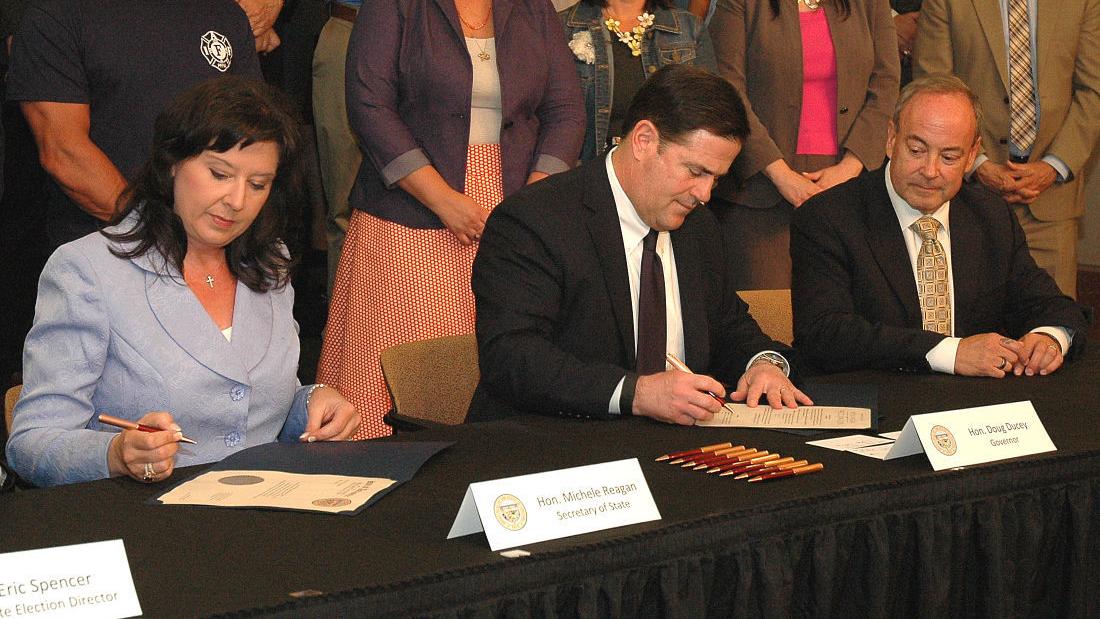
That鈥檚 not the position being taken by Ducey, who put the package together to settle a lawsuit filed by schools after the state illegally ignored the provisions of a 2000 ballot measure requiring aid to be increased each year to match inflation.
鈥淧roposition 123 is a settled issue,鈥� said gubernatorial press aide Daniel Scarpinato.
That remains to be seen.
Jacob said there may be an argument that the new federal legislation effectively blesses all the payments made in the interim. He said he and his client will make a decision, probably by the end of the week, whether to ask U.S. District Court Judge Neil Wake to rule on the question of whether a federal law dated March, 23, 2018, can affect a vote taken May 17, 2016.
It isn鈥檛 just Jacob who contends it鈥檚 too late now to salvage the $344 million in payments made the first two years of Prop. 123 plus any cash paid out so far this current school year.
鈥淚t may fix it going forward,鈥� state Treasurer Jeff DeWit said Tuesday. 鈥淐ongress actually has to overtly state it is retroactive. It does not do that.鈥�
And if Wake says they鈥檙e right, that leaves the question of how to get the money back.
Congress gave Arizona 10 million acres of federal land when it became a state in 1912. Most of that was earmarked for public education, with the idea being that proceeds from sales or leases would go into a trust. The beneficiaries 鈥� public schools 鈥� would get interest from trust earnings.
In 2010, facing a deficit, lawmakers voted to ignore the provision in Proposition 301 to adjust state aid annually to compensate for inflation. Three years later, the Arizona Supreme Court, ruling in a lawsuit filed by schools and education groups, said that move was illegal. That, however, did not end the case, sending it back to a trial judge to figure out how much schools were owed.
The plaintiffs agreed to a deal offered by Ducey: Take something less now. And Ducey, unwilling to raise taxes to finance the $3.5 billion, 10-year plan, decided to finance most of it by dipping into the trust. That, Wake ruled Monday, was illegal as the state did not first get permission from Congress.
The federal legislation may solve that going forward. But that still might leave how to recoup what has been spent.
With the money already gone, Jacob said, that leaves the option of blocking the state from making future distributions 鈥渦ntil such time they replenish what they took out.鈥�
That, however, has severe implications for schools which have put together budgets assuming the dollars will be there.
On Twitter: @azcapmedia