The federal government is likely to accept the proposal from California, Arizona and Nevada for some cuts to their river water supplies, an Arizona state official said Monday.
But the official said he's also concerned the feds will call for a much bigger cut on top of that — a cut that would slash river water use in those three Lower Colorado River Basin states by nearly twice as much as they're proposing. Such a cut would be "devastating" in Arizona, he said, speaking on condition his name and title not be used.
Not only would the larger potential cut "burn through" the entire supply of the Central Arizona Project that serves drinking water to Tucson and Phoenix, but it could also cut river water supplies to the agricultural stronghold of Yuma and water now used by riverfront communities such as Lake Havasu City and Bullhead City, he said.
The U.S. Bureau of Reclamation's final "Record of Decision" for the Colorado River is due Friday, said the state official, who also expects the bureau to release its final environmental impact statement on the river this week. Bureau spokesman Peter Soeth didn't respond to a question from the Star seeking to confirm the release date.
People are also reading…
While the Arizona official said he didn't know for sure if the bureau's final environmental report will include its preferred plan for the river, out of five alternatives it discussed in its draft environmental report in January, the release of the final report will be significant, he said.
"It is a very significant step. It is a necessary step" because it makes the actions called for in the decision enforceable, the state official said.
The Lower Basin proposal, publicly released in May, called on California, Arizona and Nevada to cut their river water use by a total of 1.25 million acre-feet a year, or a little more than 10 years' worth of Tucson Water's annual drinking water deliveries to its customers. Arizona would take 760,000 acre-feet a year of those cuts under the Lower Basin states' proposal. The proposal also called for an additional 700,000 acre-feet cut to be spread among the three states.
Late last week, the Los Angeles Times reported, and the Star confirmed, that Arizona would take a 31% cut in its total Colorado River water supply in the first round of federal cuts. A 31% cut of Arizona's total, 2.8 million acre-foot Colorado River allocation would amount to about 868,000 acre-feet.

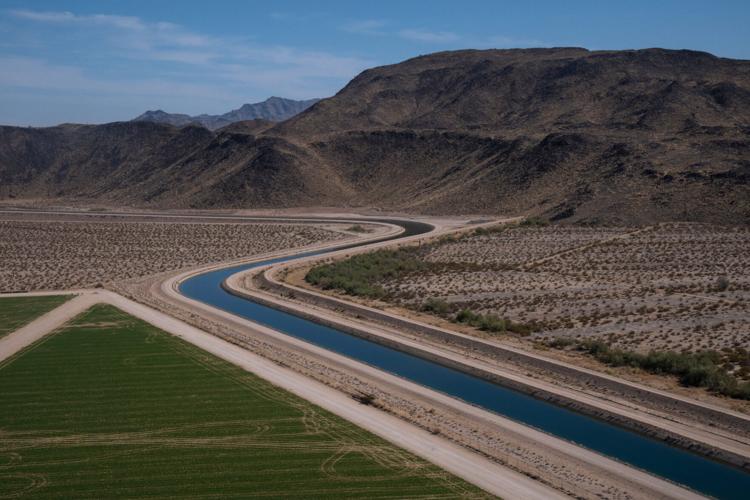
The Central Arizona Project (CAP) canal southwest of Salome, Arizona.
The Arizona official held a press briefing Monday to discuss the bureau's pending environmental report and decision. But the official said the comments could be used strictly "on background," meaning reporters could quote them, but couldn't attribute them to anyone specific.
Asked to explain the briefing's "background" status, the official said only, "We just wanted to take this opportunity to talk with you about what's ahead of us this week, and what's ahead of us is the publication of the final environmental impact statement."
"We have worked with the feds and the states to try to put together a final version of that Lower Basin proposal," which calls on Arizona, California and Nevada to reduce their total river water use by 1.25 million acre-feet in both 2027 and 2028, the official said. "There’s been a lot of good work done, a lot of compromises going on. It's still uncertain what the final proposal will look like."
He said he expected the reductions proposed by the Lower Basin states will "daylight" in the bureau's ultimate decision on the river. But less certain to be approved are numerous other policies that the Lower Basin states proposed, he acknowledged.
Chief among those is one that would require the bureau to release extra water in future years from Upper Basin reservoirs, as it did this year.
That's one of two pending issues for the final environmental impact statement that concern the Arizona official. He said he sees a real possibility that in future years, the bureau will not release any additional water from its Upper Basin reservoirs beyond what the agency slated for release this year and next year from the Flaming Gorge reservoir at the Utah-Wyoming border.
The Lower Basin states are counting on continuing to get extra water deposited in the Lower Basin from the Upper Basin reservoirs to ensure they'll get enough water.
Another concern expressed by the Arizona official is that the bureau's final decision will not require any mandatory cuts on the part of the Upper Basin states of Colorado, New Mexico, Utah and Wyoming. The bureau's draft statement didn't require such cuts. Many observers say they believe the bureau is concerned it lacks the legal authority to order such cuts when its authority to order cuts in the Lower Basin is clear.
The official noted that the bureau has also released to the states a "potential preferred alternative" for the river that would allow it to cut Lower Basin water use by a total of 3 million-acre-feet a year.Â
The Lower Basin states' proposal might add additional cuts of 300,000 acre-feet a year from both Arizona and California and 100,000 acre-feet a year from Nevada. That would boost the Lower Basin proposal's proposed cuts to 1.6 million acre-feet a year.
But that would still fall well short of what outside scientists have said is an annual shortfall of 3.6 million acre-feet a year on the river between its natural supply in the last couple years and people's demands.
Many outside scientists have said a larger cut might or will be needed.
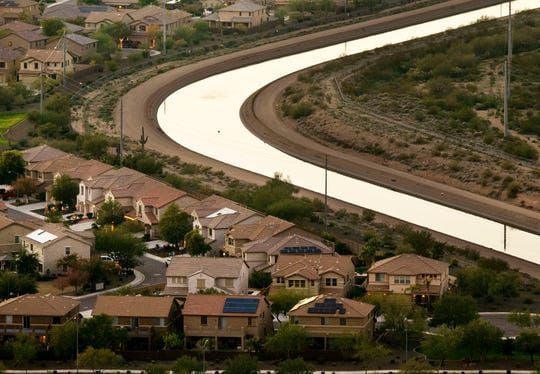
The CAP canal winds through a neighborhood in Phoenix.
At Monday's briefing, the state official said: "I would hope to see in the final EIS some computer modeling analysis that would show how the three Lower Basin states' plan would perform in relation to different hydrological scenarios" for how much water comes down the river each year.
"This will give you some idea about whether whether we may need more cuts, as you project elevations in Lake Mead," the Arizona official said. "We will be consulting with the federal government and all seven basin states to look at all the actions that might take place to further protect Lake Mead and Lake Powell and that would be the path forward."Â
But if there is a 3 million acre-foot a year cut and the cuts on Lower Basin water users are made based on their legal priority rights to river water, "Not only does it burn through all of the CAP water. It starts to impact higher priority users within my state, my folks on the river in the Yuma area," the official said.
"I can't tell you exactly how much it would affect them. It would start to impact California, mostly Metropolitan (the Metropolitan Water District serving Southern California cities); also priority users along the river in this state: Bullhead City, Lake Havasu. Those are very devastating potential impacts."
Responding to a reporter's question about the potential for litigation over a final federal decision, the Arizona official said, "The state continues as it has stated in the past, to reserve its right to protect its rights through legal mechanisms."
Asked what specifically might trigger litigation, the official replied, "I prefer not to speak to that question. We're keeping more options open."
He also acknowledged that the bureau's plan for a 10-year agreement that would be renegotiated every two years "leaves a lot of uncertainty for CAP (users) and for a lot of us."Â
Contact Tony Davis at 520-349-0350 or tdavis@tucson.com. Follow Davis on Twitter@tonydavis987.

Tony Davis
Reporter