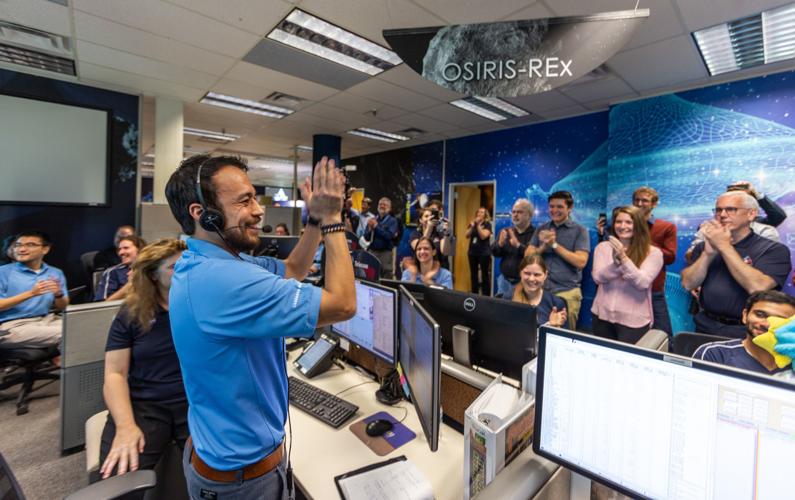
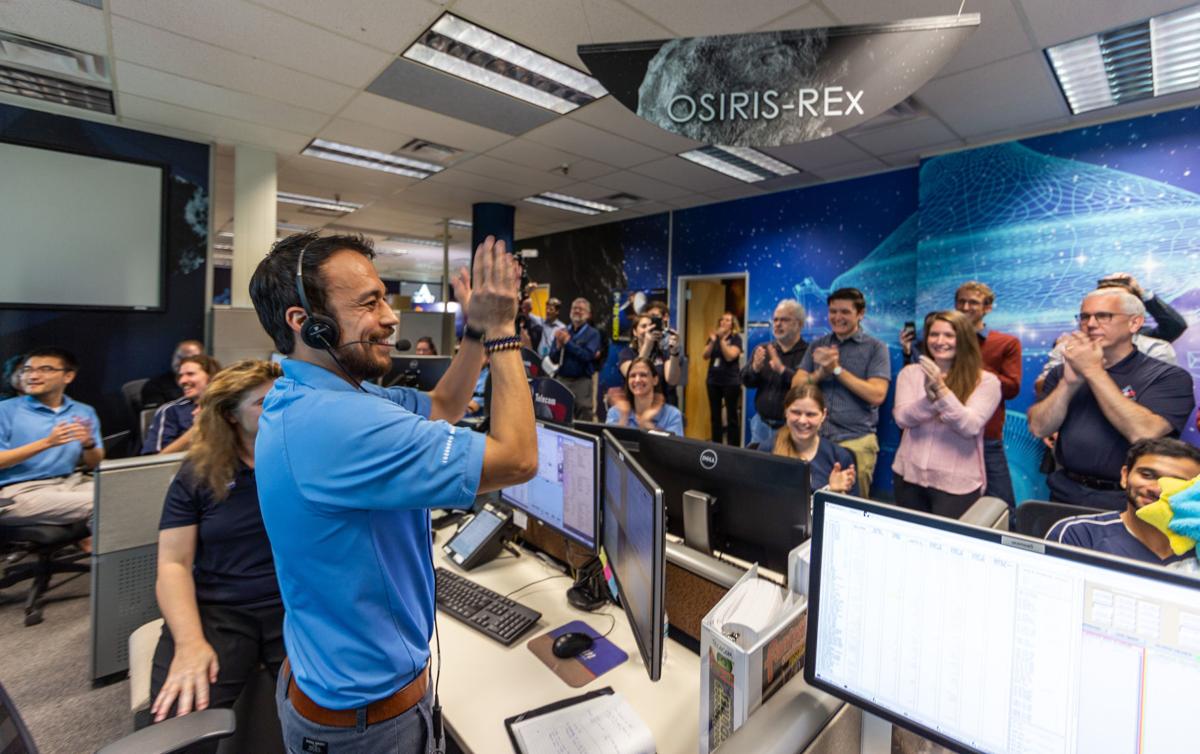
University of Arizona scientists and supporters cheered Monday morning as word came from mission control that the OSIRIS-REx mission had finally reached the asteroid Bennu.
This critical 鈥� and long-awaited 鈥� step advances the main objective of the $1 billion UA-led mission to collect a sample of the asteroid, which contains materials left over from the formation of the solar system 4陆 billion years ago and return it to Earth. Researchers hope to study the sample to learn more about the origins of the solar system and possibly life itself.
This is the first U.S. mission to return a sample from an asteroid. The ancient cargo will be the largest sample to be returned since the Apollo missions brought home pieces of the moon.
While there was no touchdown upon arrival at Bennu 鈥� the spacecraft will for now fly relatively close to the asteroid 鈥� researchers celebrated the beginning of the next phase of operations following more than two years and 1.25 billion miles of travel.
People are also reading…
UA officials and scientists working on the mission gathered at the Stevie Eller Dance Theater at the UA to await word on the spacecraft鈥檚 arrival from the Lockheed Martin mission control center in Littleton, Colorado. That notification came shortly after 10 a.m.
OSIRIS-REx must perform 1陆 years of measurements, mapping and data collection before locating the ideal sample site and heading in for the retrieval procedure.
Images captured Monday by OSIRIS-REx will be sent Tuesday, Dec. 4, as the spacecraft passes in range of the NASA Deep Space Network.
While mission planning and development started 10 years ago and the launch took place Sept. 8, 2016, 鈥淭his is the start of the grand adventure that is OSIRIS-REx,鈥� said UA professor Dante Lauretta, the mission鈥檚 principal investigator.

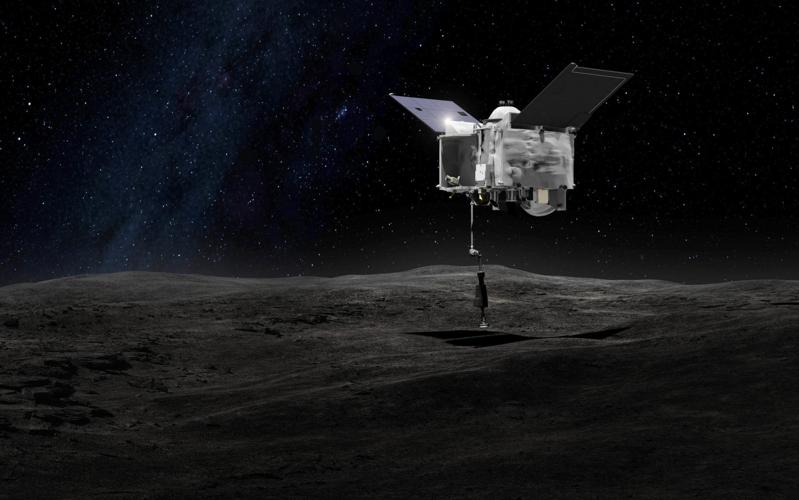
This artist鈥檚 rendering shows the OSIRIS-REx spacecraft coming in contact with the asteroid Bennu with its Touch-And-Go Sample Arm Mechanism. The mission aims to return a sample of Bennu鈥檚 surface to Earth for study.
Arrival
Since Aug. 17, when the asteroid was first seen as a point of light and the approach phase began, the spacecraft has traveled 1.4 million miles and has slowed by over 1,000 mph relative to Bennu.
During approach, researchers took the opportunity to snap photos as a 鈥渟neak peek to what we鈥檙e about to embark on,鈥� said Heather Enos, deputy principal investigator of the UA鈥檚 Lunar and Planetary Laboratory.
They found the models created using ground-based observations were highly accurate, which is good because this is what they were preparing operations for, said Daniella DellaGuistina, the UA scientist who leads image processing for the mission.
What they saw upon arrival was a dark asteroid with an extremely rocky surface, covered in boulders.
OSIRIS-REx must quickly learn to safely navigate its new environment. First, it will scope the surrounding area for hazards such as dust plumes and natural satellites.
Researchers must also learn to fly in this gravitational environment, which is difficult because Bennu is the smallest object any spacecraft has ever orbited.
鈥淲e are basically formation-flying,鈥� Lauretta said for perspective, 鈥渁nd we鈥檙e doing it with a non-cooperative target moving tens of thousands of miles per hour through space while we snap photos and make measurements.鈥�
Having learned about Bennu鈥檚 mass and hazards, OSIRIS-REx will finally be able to orbit Bennu on New Year鈥檚 Eve. The spacecraft will then spend the next 1陆 years surveying the surface and mapping it with precise resolution in order to determine the best sample site.
鈥淲e will be able to see a penny on the surface of Bennu,鈥� DellaGuistina said.
鈥淭he surface is rugged. We鈥檝e got our work cut out for us,鈥� Lauretta said. 鈥淲e will characterize it in great detail by making maps of the topography and minerals on the surface.鈥�
In early July 2020, the spacecraft will perform a touch-and-go maneuver with its 11-foot-long arm called TAGSAM. OSIRIS-REx will bounce off the surface of Bennu like a pogo stick to quickly collect pieces of asteroid no bigger than 2 centimeters across.
Then, the TAGSAM arm will turn its stolen treasures toward the cameras so mission control can see what it has collected. The arm will also measure the mass of the sample size; Lauretta hopes for at least 2 ounces.
When the sample capsule returns to Earth on Sept. 24, 2023, Lauretta said they鈥檒l get the material back to the UA as soon as possible. Multimillion-dollar renovations have been made to the basement of the Kuiper Space Sciences building to facilitate the study of these minuscule samples.
鈥淲e can see the world in a grain of sand,鈥� he said.

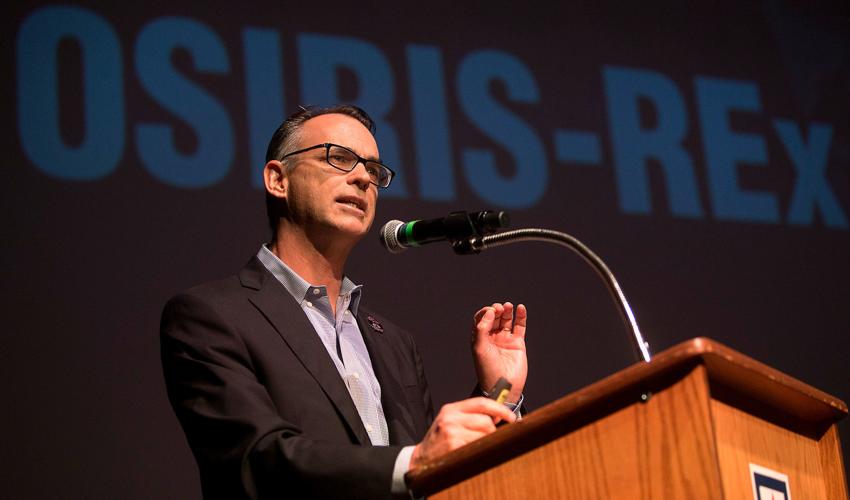
Dante Lauretta, principal investigator for the OSIRIS-REx mission, talks during a celebration on OSIRIS-REx reaching the asteroid on December 03, 2018.
UA鈥檚 role
The mission鈥檚 science operations command center is located at the UA鈥檚 Lunar and Planetary Laboratory in Tucson and is part of a long legacy of UA involvement in planetary exploration, said College of Science Dean Joaquin Ruiz at Monday鈥檚 celebration.
鈥淚n the school鈥檚 new strategic plan,鈥� as unveiled by UA President Robert Robbins at the November Board of Regents meeting, 鈥渟pace exploration plays a prominent role,鈥� Lauretta said. 鈥淭hat鈥檚 not a coincidence. We鈥檝e been part of space exploration since the dawn of the Space Age.鈥�
To create the camera suit aboard OSIRIS-REx, LPL reached out to the larger UA community for help. LPL worked with scientists at the Steward Observatory, the College of Optical Sciences, the College of Engineering and more to build OCAMS.
The UA has also been involved in nearly every major NASA-funded planetary science mission including HiRISE, the High Resolution Imaging Science Experiment.
鈥淎ny time there鈥檚 an image of Mars,鈥� Ruiz said, 鈥渋t鈥檚 us; HiRISE is ours.鈥�
The UA was also involved in the Dawn mission to Vesta and Ceres in the asteroid belt, the Juno mission to Jupiter and the New Horizons mission to Pluto.
The UA was also the first public university to be awarded a principal investigator-led mission when it was chosen to lead the Phoenix Mars mission.
The OSIRIS-REx endeavor also directly impacts students, Robbins said.
About 150 UA students have worked on OSIRIS-REx while studying at the UA, while more than 30 former students have been hired as mission staff after graduation. Moreover, the UA estimates the economic impact to Arizona has been about $231 million. Of that, $173 million comes to Tucson.
Looking ahead
The UA is already looking ahead at missions to come. LPL director Timothy Swindle outlined a few of the department鈥檚 future NASA missions at the celebration Monday.
The James Webb Space Telescope is scheduled to launch in March 2021. It will be a powerful successor to the Hubble Space Telescope. The Near-Infrared Camera central to the telescope was developed by a group led by Marcia Rieke, a regents鈥� professor of astronomy in the UA Steward Observatory.
In 2017, NASA announced its decision to fund the $40 million UA-led GUSTO mission that seeks to launch a balloon into near space carrying a telescope to study the interstellar medium, the gas and dust between the stars from which stars and planets form.
NASA has yet to announce the winner of the fourth mission in the New Frontiers program, but the UA-involved CAESAR (Comet Astrobiology Exploration Sample Return) is one of the finalists.
OSIRIS-REx was the third mission chosen for NASA鈥檚 New Frontiers Program. The first was New Horizons and the second was the Juno mission.
CAESAR would send a medium-sized spacecraft to a comet, snag a small sample and return it to Earth for analysis.
The CAESAR team is led by Cornell University, but both OSIRIS-REx鈥檚 Lauretta and LPL鈥檚 Thomas Zega, an OSIRIS-REx collaborator, will participate in sample analysis.
But at Monday鈥檚 arrival celebration, Lauretta鈥檚 mind was solely on OSIRIS-REx.
He said he can鈥檛 wait to get back to work: 鈥淭he scientific adventure can begin now.鈥�