

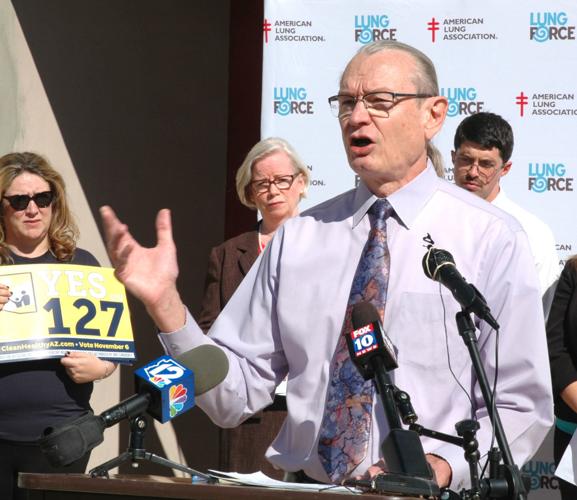
PHOENIX 鈥� Public health advocates urged voters Tuesday to support a renewable energy mandate on the November ballot even though they were unable to say how much of a difference it actually would make in ground-level air pollution.
And a state utility regulator urged a vote against Proposition 127, even though he conceded that his colleagues 鈥� who already have the power to mandate more renewables 鈥� have yet to do much about it.
Phoenix is one of the 10 worst areas in the country for ozone pollution, said JoAnna Strother, regional director for public policy for the American Lung Association.
鈥淭here are compelling health reasons why Proposition 127 makes sense from the public health perspective,鈥� said Mary Ellen Cunningham, president of the Arizona Public Health Association.
鈥淭he bottom line is, burning fossil fuel, including natural gas, creates air emissions,鈥� she continued. 鈥淭hat鈥檚 oxides of nitrogen and volatile organic compounds. And that鈥檚 ozone.鈥�
People are also reading…
But standing outside the association鈥檚 office near a busy Phoenix intersection, no one could say what percentage of pollution being inhaled was due to power plants versus vehicle traffic.
鈥淎s much as it would be desirable to have exact precise forecast numbers on every issue, sometimes you just can鈥檛 answer the question,鈥� said Dr. Bob England, a former Maricopa County health director.
But England argued that instinctively the air would be better if Prop. 127 is approved than if it is not and utilities remain free to go ahead with plans to build more gas-fired power plants.
鈥淚 can鈥檛 give you a number how much is going to happen 20 years from now,鈥� he said, saying variables include the kind of transportation available and what鈥檚 being used to fuel vehicles.
鈥淪ome things you just can鈥檛 answer,鈥� England said. 鈥淏ut common sense says you don鈥檛 want to go the other direction.鈥�
Prop. 127, if approved by voters, would constitutionally require most utilities to generate at least 50 percent of their power from renewable sources by 2030.
What is known is that utilities are looking at additional gas-fired plants in that time frame, plants that Dylan Sullivan of the Natural Resources Defense Council said would not be needed if utilities were forced instead to get more of their power from renewable sources. And Sullivan cited figures predicting a 51 percent reduction in nitrogen oxides, a precursor of ozone, by 2030.
But that is a reduction in what comes from power plants and does not reflect various other 鈥� and larger 鈥� sources of pollution. And there is some data to suggest that the pollution from gas-fired power plants is a very small portion of what affects most urban dwellers.
In Pima County, for example, 46 percent of nitrogen oxides come from on-road vehicle use. By contrast, 20 percent is from 鈥減oint sources,鈥� of which Pima County records show more than half is from the CalPortland cement plant in Rillito and 34 percent of that 20 percent 鈥� or less than 7 percent 鈥� comes from Tucson Electric Power鈥檚 gas-fired Irvington power plant.
Joe Barrios of TEP said there is a plan to build one new higher-efficiency gas-fired power plant. But he said most future needs will be met with solar and wind, to the point where TEP could get to 30 percent renewable by 2030.
Arizona Public Service has plans to build what could amount to an additional dozen gas-fired power plants between now and 2030, presumably in the Phoenix urban area.
But Jeff Burke, the company鈥檚 resource manager, said that鈥檚 not set in stone.
鈥淲hen solar with a battery is competitive, we鈥檒l take it,鈥� he said, saying the key is meeting future energy needs in the most efficient way possible. 鈥淲e鈥檙e trying to do an all-of-the-above approach.鈥�
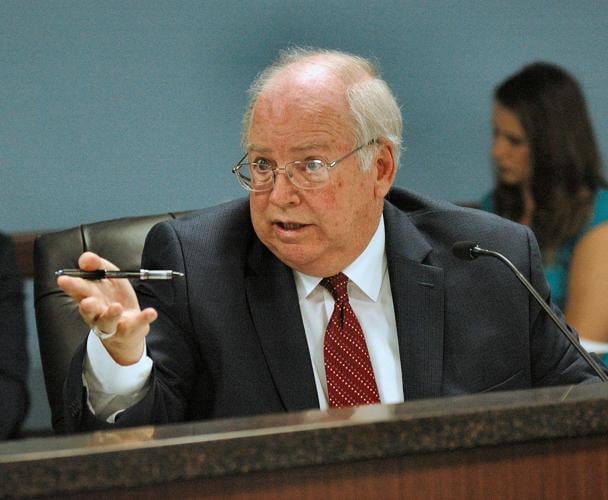
Also Tuesday, Andy Tobin, one of the state鈥檚 five utility regulators, came out against Prop. 127. Tobin said questions of what are appropriate resources should be left to him and his colleagues on the Arizona Corporation Commission. And he said having standards set by the commission provide more flexibility as needs 鈥� and costs 鈥� change, versus a constitutional mandate for 50 percent renewables.
He conceded, though, that the five-member, all-Republican commission to date has done very little to convince the public that it is really interested in pursuing more renewable energy. In fact, the current standard for utilities of 15 percent renewable energy by 2025 has not been changed since 2006.
鈥淭hey don鈥檛 want to pull the trigger,鈥� he said of his colleagues. 鈥淚鈥檓 very frustrated.鈥�
That, Tobin said, could lead voters to decide that the only real way to get any meaningful action is by approving Prop. 127.
Tobin crafted his own plan nearly a year ago for an 80 percent 鈥渃lean鈥� energy standard. But utilities would not need to reach that goal until 2050. And they could meet some of that with nuclear power.
What鈥檚 particularly annoying, Tobin said, is that his plan was on the table months before there even was a Prop. 127, much less the more than $8.2 million in funding to support it from California billionaire Tom Steyer.
And he even got the commission to approve a moratorium on new gas-fired power plants 鈥� the ones the utilities say in their long-term plans they intend to build 鈥� until the end of the year. The premise, Tobin said, is that it would give the regulators a chance to review, adjust and finally adopt his plan before utilities start construction.
But Tobin has yet to get the votes to actually advance his plan. Still, he said, voters should have faith that the commission eventually will act on his plan, or some variation of it, and reject Prop. 127.
Campaign spokesman D.J. Quinlan acknowledged that the commission could increase the current renewable energy standard, including adopting the Tobin plan. But he questioned whether the commission, at least as currently constituted, would pursue anything that Arizona Public Service, the state鈥檚 largest utility and source of $11 million in funds so far to fight the initiative, does not support.
鈥淚 think there鈥檚 a reason why APS spent millions of dollars electing their hand-picked corporation commissioners,鈥� he said.
That refers to $4.2 million that Pinnacle West Capital Corp., APS鈥� parent, admitted spending in 2016 to defeat Democrat candidates for the commission. And Pinnacle West will neither admit nor deny it was the source of $3.2 million spent to elect Republicans in 2014.


