
PHOENIX — Democratic Attorney General Kris Mayes is once again at odds with Republican legislative leaders. And, once again, the issue surrounds the right of Arizonans to obtain an abortion.
Mayes has decided to side with the American Civil Liberties Union, which is challenging state laws that bar certain "advanced practice clinicians,'' such as specially trained nurse practitioners, from providing abortion services. They are asking a Maricopa County judge to declare the restrictions unconstitutional.
What makes that significant is that Josh Bendor, the solicitor general in Mayes' office, said Arizona law generally requires the Attorney General's Office to defend state laws when they are challenged in court. But he said that doesn't apply "when there is not a plausible argument'' to make, which he said is the case here since voters in 2024 agreed to put a right to abortion into the Arizona constitution.
People are also reading…
In turn, that has resulted in House Speaker Steve Montenegro and Senate President Warren Petersen hiring their own private lawyers at taxpayer expense to ask the judge to toss the case.
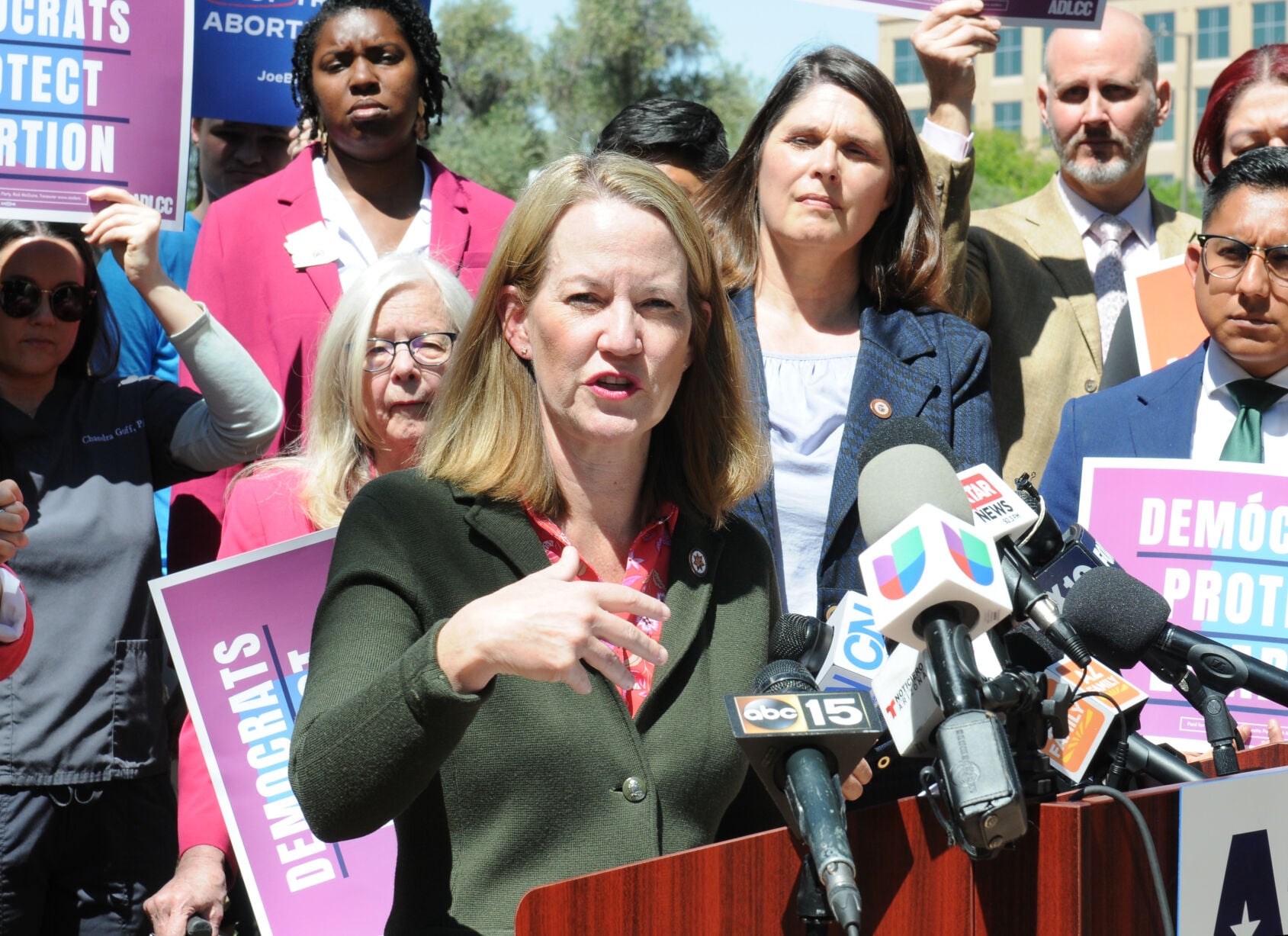
Attorney General Kris Mayes at a 2024 rally about abortion rights.
Neither GOP leader would respond to questions about their decision to defend a law that Mayes and Bendor say is legally indefensible.
"To me, the question is, why is the Legislature spending taxpayer money to defend these kinds of things in the face of the will of the voters?'' Bendor said.
How quickly there can be a ruling is unclear. At a court hearing earlier this week, attorneys provided no timeline for when they would be ready to bring the case to court.
'Fundamental right'
Central to the ACLU lawsuit is the fact that the state Board of Nursing, which regulates advanced practice nurses, concluded in 2008 that they can safely perform first-trimester abortions.
They are a subset of registered nurses who, by virtue of advanced education and training, have a broader scope of practice than registered nurses. They also can hold specific licenses, such as certified nurse midwife and nurse practitioner.
The Republican-controlled Legislature responded almost immediately with a measure stripping the nursing board of its power to decide who can perform the procedure.Â
What changed since then is that voters in November 2024 approved Proposition 139 by a 3-2 margin.
It added language to the Arizona Constitution providing a "fundamental right to abortion'' prior to fetal viability, generally considered between 22 and 24 weeks. ACLU attorneys say the only exception is when there is a "compelling state interest that is achieved by the least restrictive means.''
It is now up to Superior Court Judge John Blanchard to decide the scope of the voter-approved initiative.
Challengers say the wording is on their side.
"The fundamental right to abortion means little when Arizonans cannot get care from a trusted and skilled provider in their own community,'' said Lauren Beall, a staff attorney at the ACLU of Arizona. "Overturning senseless restrictions that tie the hands of advance practice clinicians is the next step to fulfill the promise of the Arizona Abortion Access Act.''
'Compelling state interest'
Montenegro and Petersen, through their lawyers, are taking a contrary position.
"None of the challenged provisions denies, restricts, or interferes with the right to abortion,'' they are telling Blanchard.
And if that argument doesn't work, they have another one — linked to the exception within the amendment.
They contend that, if nothing else, each of the restrictions "is justified by a compelling state interest that is achieved by the least restrictive means.'' But the legal papers filed so far on their behalf do not explain that claim.
Bendor, however, said the way he and Mayes see it, there is no legal basis for the GOP lawmakers to argue that the restrictions remain enforceable.
"The standards changed a lot when voters enacted Prop. 139,'' he told Capitol Media Services. "It sets a pretty high burden for laws to meet to restrict the right to abortion.''
It was that touchstone, Bendor said, that his office used to evaluate the legal restrictions on advanced practice nurses. He said these are restrictions that exist "even though nurses have done so historically, have done so elsewhere, do other gynecological things that are more complicated.''
"We determined that these restrictions don't meet the constitutional requirements,'' he said. Conversely, Bendor said, the Attorney General's Office had no good arguments why the laws would pass muster, even with the exceptions built into Prop. 139.
He said the decision to side with challengers was not made lightly.
"As a matter of process, we start with the assumption that our job is generally to defend state law,'' Bendor said.
"But when there just is not a plausible argument in defense of a given state law, then it's not in the public interest or within our responsibility to do so,'' he said. "And that's more likely to happen when you have an intervening change in constitutional law that then calls into question statutes that were enacted without that constitutional provision even in mind because it didn't exist at the time.''
All that leads to "a very different calculus'' in terms of the role of the Attorney General's Office, Bendor said
In fact, he said, that is the same sort of calculus that should have, but did not, affect the decision by GOP lawmakers to defend a law despite the intervening change of the adoption of Proposition 139.
Procedure not consistently available statewide
The fight over the restrictions, according to challengers, has real-world impacts.
In their legal filings, they said that since that ban took effect, abortion has only been consistently available in Pima and Maricopa counties, while there have been "interrupted and limited services'' at a single clinic in Coconino County. The requirement that only doctors can provide abortions, the challengers argue, means patients can often have to drive for hours.
They also claim there is no medical reason for the law, backing that up with a statement from the American College of Obstetricians and Gynecologists, which says bans like the ones in Arizona "are not based in science, improperly regulate medical practice, and impede patients' access to quality, evidence-based health care.''
Also, the U.S. Food and Drug Administration, in approving the drugs used in medication abortions, has authorized advanced clinicians to provide medication abortions.
Also involved, the challengers say, is the right of women to make choices for themselves.
"People choose their health care provider, whether a physician or an APC, for various reasons, some deeply personal,'' the lawsuit states. "Particularly when it comes to abortion care, they may have a strong preference for a trusted provider they have seen for other primary or reproductive health care.''
And sometimes, the lawsuit says, it can be as simple as people preferring a clinician to a doctor, wanting someone who can see them quicker, or who is closer to their home.
"By overriding people's choice or provider, for no medical reason, the APC ban violates their autonomy," the lawsuit says.Â
Previous cases
This isn't the first time Mayes has declined to defend abortion laws that were in existence when Proposition 139 was approved.
She took a similar stance when the ACLU and the Center for Reproductive Rights filed suit in 2025, challenging a series of prior existing laws.
Those laws included a 24-hour waiting period before a woman can terminate a pregnancy; and a ban on doctors performing an abortion if they have reason to believe the patient is seeking the procedure because of a fetal genetic defect. Challengers also sought to void a prohibition on the use of telemedicine in abortion cases — including a ban on the mailing of abortion pills to patients.
"We have determined that the three laws that the plaintiffs are challenging here are unconstitutional and cannot withstand tests that the voters stood up when they amended the constitution to protect abortion rights,'' Mayes said at the time.
All of those laws were later voided by a trial judge who rejected arguments by GOP lawmakers that they remained enforceable despite voter approval of Proposition 139. That ruling, however, remains on appeal.
There is also a separate but related issue playing out in federal court where Louisiana got a federal appeals court to ban telehealth abortions — and, specifically, the shipping of abortion pills — based on the argument it allowed its residents to circumvent that state's abortion ban. But that ruling has been paused by the U.S. Supreme Court.
Howard Fischer is a veteran journalist who has been reporting since 1970 and covering state politics and the Legislature since 1982. Follow him on X,  and Threads at @azcapmedia or email azcapmedia@gmail.com.