
PHOENIX聽鈥斅燗rizona Attorney General Kris Mayes will have to start from scratch if she hopes to charge those involved in the "fake elector'' scheme.
In an 18-word order Thursday, the Arizona Supreme Court left intact the ruling by Maricopa County Superior Court Judge Sam Myers that the original 2024 indictment was legally flawed.
Myers said grand jurors were never given a copy of the 1887 federal Electoral Count Act, which directed Congress how to handle it when they get multiple slates of electors from any state. He said that denied them information that could have made a difference in their decision on whether to indict.
The defendants were indicted on charges they submitted false documents after the 2020 presidential election claiming that Republican Donald Trump won Arizona聽鈥� and that they were the state's legitimate electors聽鈥� despite the fact that Democrat Joe Biden defeated him by 10,457 votes.
People are also reading…
In upholding the lower court ruling, the justices rejected arguments by Mayes that the federal law "provides no defense to the state fraud, forgery, and conspiracy charges.'' The attorney general had no better luck with claims that instructing the grand jury on the federal law "would be misleading at best.''
A spokesman for Mayes said she intends to pursue the case with a new grand jury but said he could not comment on how soon that might happen.
But questions remain of whether this ever will go to court.
First, there is another legal issue that has to be resolved: whether Mayes violated the state's Strategic Lawsuit Against Public Participation law.
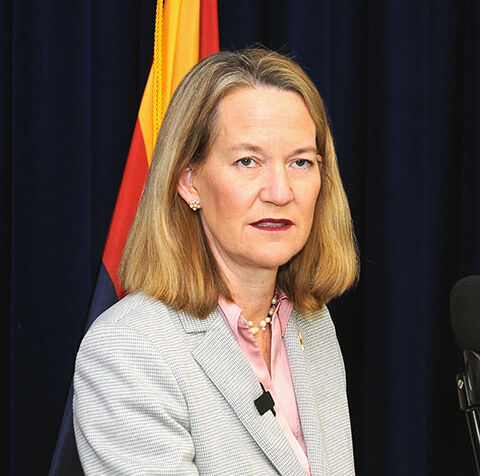
Mayes
SLAPP, as it is known, is designed to prevent public officials from using the courts to punish and prevent speech on political issues. Myers, in a preliminary ruling last year, said there was enough presented to him to believe the indictment against the 11 electors and their allies appeared to attack what is "at least in part some arguably lawful speech.''
Resolution of that issue was put on the back burner until there was a final ruling about whether the underlying indictment would be thrown out.聽
There also is a separate bid by Christina Bobb, one of Trump's former lawyers who is among those indicted, to have Mayes and her office disqualified.
She says much of the case was prepared not by the Attorney General's Office but instead by States United Democracy Center.
A copy of the organization's 47-page report, obtained by Capitol Media Services, shows that States United provided a timeline of events leading up to the 11 Republicans submitting their statement to federal authorities claiming that they were the true electors. That report also included a list of charges that States United said were violated and why each applied in the case.
The final indictment by Mayes nine months later used three of those charges聽鈥� forgery, fraudulent schemes and artifices, and conspiracy聽鈥� and added a lower level of fraudulent schemes and practices. All totaled, 18 were indicted; Trump himself was listed as an unindicted co-conspirator.
Bobb's attorney is telling Myers that donations were made indirectly by groups related to States United to a legal defense fund set up to help Mayes pay her bills in her separate legal fight with Abe Hamadeh, who challenged Mayes' win in the 2022 race for attorney general.
Also, at the rate the case is proceeding聽鈥� especially with having to essentially start over聽鈥� there is a good chance it will extend beyond this year. Both Warren Petersen and Rodney Glassman, the GOP candidates trying to oust Democrat Mayes in the November election, have told Capitol Media Services they will drop the case if elected.
Anthony Kern, one of those charged as a fake elector, blasted Mayes for deciding to seek a new indictment.
"She should be tired of spending taxpayer money on frivolous, lawfare-type court actions,'' he said.聽
Attorney Mark Williams, who represents Rudy Giuliani, a Trump attorney indicted for his part in what Mayes called a conspiracy, said Mayes "brought the frivolous case to punish Mr. Giuliani and other Republicans for exercising their constitutional rights."
He also noted that Mayes has now lost on the issue not only before Judge Myers but also the Court of Appeals and, now, the Arizona Supreme Court.
"There is a message in all of that for Ms. Mayes,'' he said.
Anthony Pacheco, attorney for Tyler Bowyer, an executive with Turning Point USA who also was one of the GOP electors, said the Supreme Court "got it exactly right'' when the justices tossed the indictment. He said Mayes should end the case.
"It never should have been brought in the first place because Tyler Bowyer did nothing wrong,'' Pacheco said.
Ashley Adams represents John Eastman, another Trump attorney who was accused in the indictment of drafting the scheme of sending multiple electoral slates to Washington. Adams聽said there's no basis to keep the case alive, calling the prosecution "fundamentally flawed.''聽聽
Adams said all the defendants acted in accordance with the federal Electoral Count Act.
"There's really no evidence they engaged in criminal conduct,'' she said. "And rather than dismiss the charges, she continues to pursue a pretty costly and divisive case.''
Anthony Kenney, who represents former state GOP Chairwoman Kelli Ward and her husband, Michael, both of whom signed paperwork saying they were legitimate electors, declined to comment.
State Sen. Jake Hoffman, who also was one of the GOP electors, said Thursday's Supreme Court order is "yet the latest in a long string of embarrassing losses for Mayes' tenure as Arizona attorney general.''
"This naked political persecution of her enemies is nothing more than a total perversion of Arizona's justice system,'' said the Queen Creek Republican.聽
Mayes says the 11 who signed the paper claiming they were the rightful electors, along with others aligned with Trump, were part of a scheme to undermine the results of the 2020 election. The plan, the indictment states, was to create enough doubt in the results in Arizona and other battleground states by submitting paperwork claiming they were the legal electors.
Mayes contends this was designed to get Vice President Mike Pence, who was the presiding officer of the Senate, to refuse to accept the official results from Arizona and the other states. That would have prevented Biden from getting the necessary 270 electoral votes needed to win, a move that could have allowed Congress to give Trump an immediate second term.
A total of 16 of the original 18 defendants remain in the Arizona case.
Jenna Ellis, one of Trump's attorneys, entered into a deal to have the charges against her dismissed based on a promise to cooperate with prosecutors.
And Loraine Pellegrino, one of the 11 electors, pleaded guilty last year to a single misdemeanor charge of filing a false instrument.
Votebeat reports that similar "fake elector" cases in Georgia and Michigan have been dropped but that a case is moving forward in Wisconsin. A judge is considering the fate of another case in Nevada.
Howard Fischer is a veteran journalist who has been reporting since 1970 and covering state politics and the Legislature since 1982. Follow him on X, formerly known as Twitter, , and Threads at @azcapmedia or聽email聽azcapmedia@gmail.com.