

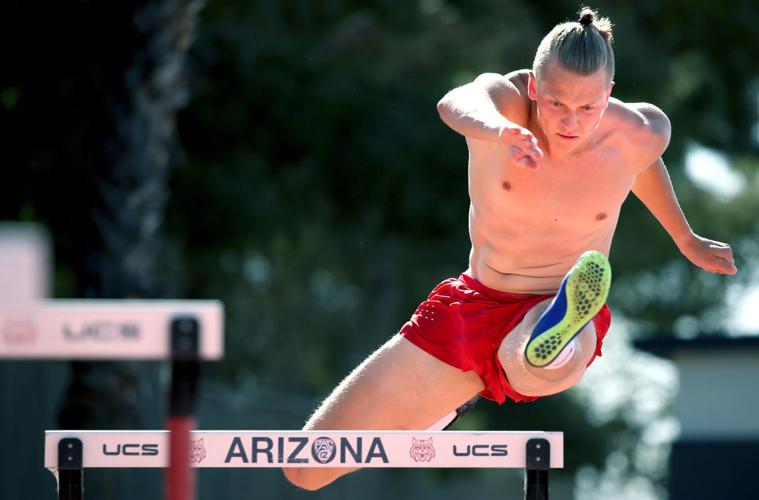

When UA track and field coach Fred Harvey talked to the legendary Edwin Moses about the 400-meter hurdles, they came up with an apt saying about the event: If you don鈥檛 like running with pain, the 400 hurdles isn鈥檛 for you.
Competitors in the event sprint for nearly a quarter mile. They must concentrate on keeping an even stride to gracefully leap over 10 hurdles spaced 35 meters apart. The runners produce lactic acid that stings the muscles, and they might be inclined to slow down. That鈥檚 when elite runners learn to 鈥渒eep on trucking,鈥� even while in pain, Harvey said.
Over the last half-dozen years, Harvey has coached two athletes 鈥� Georganne Moline and Sage Watson 鈥� who not only ran in pain but excelled in the 400-meter hurdles. Moline placed fifth in the 2012 London Olympics; Watson competed in the 2016 Rio de Janeiro games and won the 2017 NCAA championship.
People are also reading…
Now come Karolina Pahlitzsch and Maksims Sincukovs, who have the talent to become outstanding collegiate hurdlers. They get the benefit of Harvey鈥檚 coaching and being on the same training field as Moline and Watson; both UA grads who are now volunteer coaches.
Pahlitzsch and Sincukovs will make their UA debuts in the 400 hurdles Saturday, when the Wildcats host the Jim Click Shootout at Drachman Stadium. The Wildcats will shoot it out for team scoring honors Saturday against Auburn, Cincinnati, Kansas State, Illinois and Ohio State. The men鈥檚 decathlon and women鈥檚 heptathlon take place Thursday and Friday.
From Germany, Latvia
The Berlin-born Pahlitzsch won the 2011 German championship in the 400 hurdles for athletes 18 and under. She enrolled at Nebraska, where she finished 20th at the NCAA finals two years ago. She learned about Harvey鈥檚 expertise in her event and decided to transfer to the UA last year. Pahlitzsch redshirted while recovering from foot surgery.
鈥淜arolina has the speed of a 400-meter runner and the strength of an 800-meter athlete,鈥� Harvey said.
Sincukovs came to the UA from Latvia and has international running experience. He shined last year in Finland, recorded a time of 50.35 seconds 鈥� the world鈥檚 12th-best time for runners under age 19 in the 400 hurdles.
Harvey describes Sincukovs, who stands 6 feet 4 inches, as being in top physical condition and running with 鈥渁 beautiful stride mechanically between hurdles.鈥�
Sincukovs 鈥渋s everything I thought he鈥檇 be,鈥� Harvey said.
Sincukovs has run 47.1 in his 400-meter leg of the men鈥檚 4-by-400 relay team. Harvey thinks Sincukovs can go much faster.
The hurdles expert
Harvey has been a fixture at the UA for more than 30 years. He鈥檇 been a sprinter in high school in San Jose, California, and in college at Cal Poly San Luis Obispo. After graduation, he coached the Cal Poly women sprinters as an unpaid volunteer. When a coaching opening occurred on the UA staff in 1987, he jumped at the chance and got the job.
Harvey soon learned about the many misconceptions regarding the 400 hurdles.
鈥淪ome people thought that if you had a great 400-meter runner on your team, that he or she could automatically be a great 400-meter hurdler,鈥� Harvey said. 鈥淭hat鈥檚 not true.鈥�
Wanting to learn more about the event, Harvey received advice from Andre Phillips, a high school friend and the 1988 Olympic gold medalist in the 400 hurdles. Then Harvey began talking to Moses, the premier 400-meter hurdler of his era and Olympic gold medalist in 1976 and 1984.
鈥淚t became intriguing to me and a challenge to be able to develop athletes to understand self-control during a race, how to gain speed and the actual mechanics of becoming a great long hurdler,鈥� said Harvey, who became Arizona鈥檚 head coach in 2003.
One of Harvey鈥檚 first UA hurdlers to enjoy success in the 400 hurdles was Michelle Johnson, a four-time All-American and 1999 World Championship team member.
Another was Nnenya Hailey, who took sixth at the 2015 NCAA Championships in the 400 hurdles. She transferred from Clemson to run for Harvey. Hailey doubled as an outstanding athlete in the 100-meter high hurdles, which Harvey also coaches.
Dave Murray, the UA head track coach in 1987 who hired Harvey, said Harvey is 鈥減robably as good a 400 hurdles coach as you鈥檒l find in the country. That鈥檚 my opinion.鈥�
The two graduates
Moline chose Arizona 鈥� and Harvey 鈥� after Arizona State showed only lukewarm interest in her abilities. She came into her own during her junior year, finishing second in the U.S. Olympic Trials and qualifying for the 2012 London Olympics. She finished fifth in the Olympic finals, a major accomplishment for the race鈥檚 youngest athlete.
An injury kept Moline from the 2016 Olympic Trials. Injury again struck last year, but she鈥檚 gotten off to a strong start this year. She ran on the U.S. 4x400 relay team that won the IAAF World Indoor Championships in England. She will be running in the professional Diamond League circuit later this year.
Moline said Harvey has both helped with technique and confidence.
Watson was a Florida State transfer who came to Tucson to train under Harvey. After her junior year here, she made the Canadian team in the 400 hurdles and advanced to the semifinals of the 2016 Summer Games. She also ran the anchor leg on Canada鈥檚 4x400 relay team, which finished fourth, just missing a bronze medal.
Watson won an NCAA championship for the UA last year, capturing the 400 hurdles in 54.52 seconds. She recently traveled to Australia and will compete next week in the Commonwealth Games.
鈥淚鈥檓 lucky to have him as my coach,鈥� Watson said about Harvey. 鈥淚鈥檝e learned a lot about stride pattern and technique from him. He has taught me a great deal about how to improve my times and technique. He鈥檚 an amazing coach.鈥�


