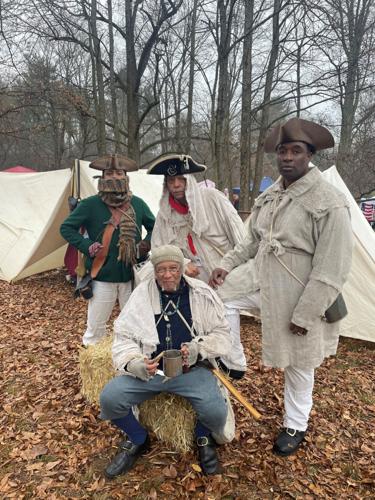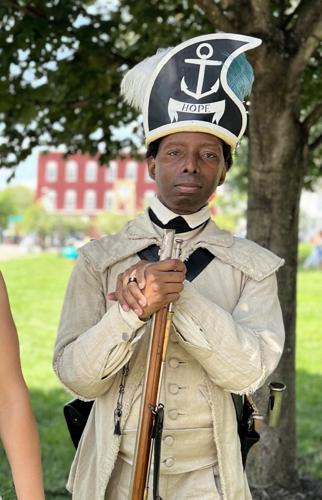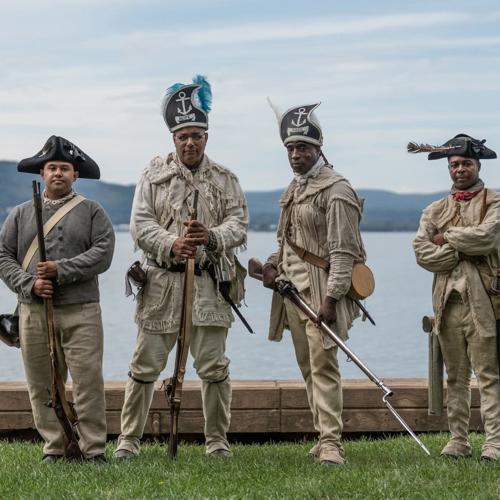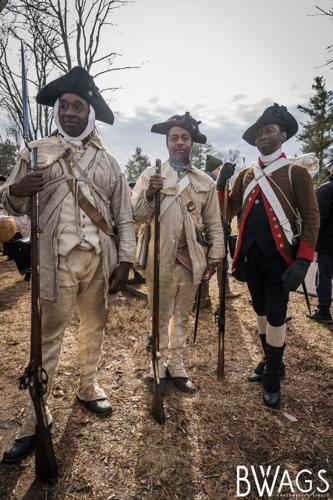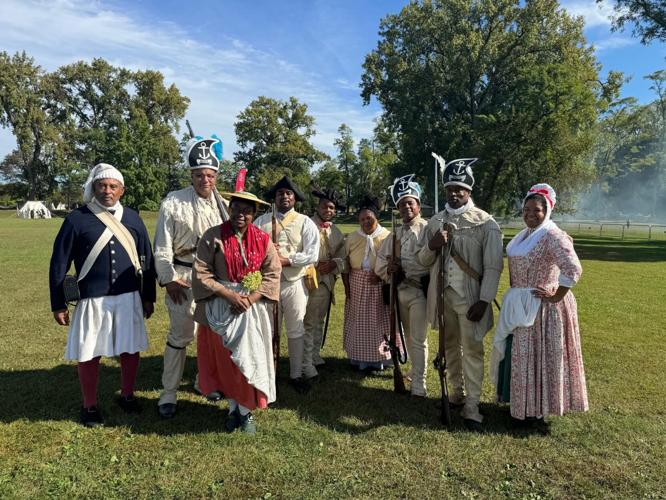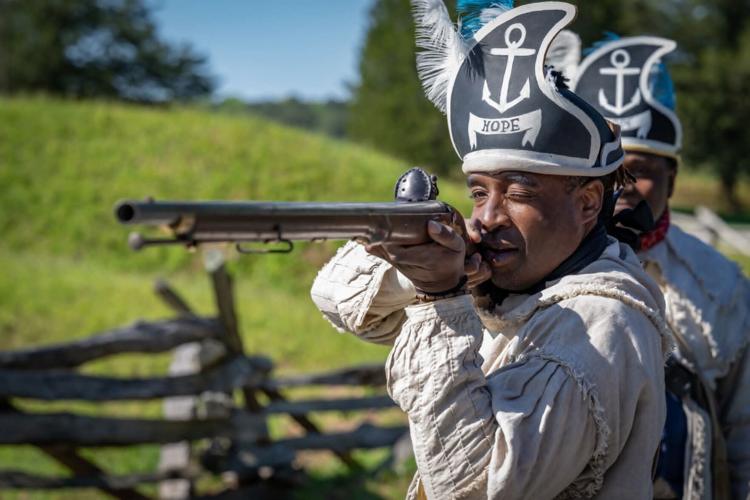

Kevin Chapman, right, with members of the First Rhode Island reenactors
There's something about a solider.
Something about the crisp uniform, the erect posture, the disciplined movements, the upturned eyes.
Something that says: I am a man, not a slave.
"The manly, soldierly type is looked at with a lot of respect in our society," said historical interpreter Kevin Chapman.
So it's not hard to imagine what it might mean to a person of color, in the slaveholding America of 1776.
"I'm no longer just some Black person at the lower end of the spectrum working at menial jobs," Chapman said. "I fought for this country. I bled for this country. I am a veteran."
Dressed to kill
It's a perspective Chapman tries on for size — along with his buff-colored hunting jacket and his tall regimental hat with the ostrich plume — each time he joins his colleagues at a meeting of the First Rhode Island Regiment, based at Trenton, New Jersey, part of the 6th United States Colored Troops Reenactors Inc.
People are also reading…
This is the only Black Revolutionary War reenactor unit in the U.S. (they can't be called African American, Chapman says, because in 1776 they wouldn't have been considered citizens).
And right now, on the eve of the semiquincentennial — America's 250th Birthday, this July 4 — they're more than usually busy. "We are booked almost every weekend throughout the year," Chapman said.
Some 5,000 non-white enlistees are believed to have served, on the patriot side, in the American Revolution.
It's a part of history that — now more then ever — is at risk of being papered over.
Not just because it it's a fine example of American diversity, at a time when diversity is, officially, suspect. But also because it calls attention to another, less comfortable fact: that three times as many Black people, 15,000 or more, enlisted on the British side. And who can blame them?

First Rhode Island reenactors
Choosing sides
"The British were more consistently explicit about the opportunity to earn their freedom," said educator Brad Fay, a program director for the National Washington-Rochambeau Revolutionary Route Association (W3R)
Fay, as a public educator, and Chapman, as a reenactor, both have an abiding interest in The 1st Rhode Island Regiment.

Antoine Watts of the First Rhode Island reenactors
Sometimes called Varnum's Regiment, after the general who organized it. And sometimes called The Black Regiment — after the fact that, at a crucial juncture, it was composed substantially of people of color.
"That is a rare thing in the Revolution," Chapman said.
Members of that unit were present during a famous, and famously bloody, episode in Yorktown: the Oct. 14, 1781, assault on Redoubt 10, in which 400 continental soldiers led by Alexander Hamilton overwhelmed a key British outpost.
The soldiers were ordered to remove the the flint from their muskets — a single, accidental discharge might ruin the surprise attack. It's a moment recalled in the musical "Hamilton": "Take the bullets out of your gun, We move undercover and we move as one."
"The assault on Redoubt No. 10 was badass," Chapman said. "They fixed bayonets. You have pioneers in the lead with axes. You're charging and you're not stopping. This is brutal, hand-to-hand, nasty, you-remember-the-guy-you-killed sort of combat. They were in it to kill."
Two days later, British general Charles Cornwallis surrendered. The war was over.

The "camp followers" were as important as the soldiers. Many were women.
Controversy and opposition
People of color served elsewhere, and in other ways. Sometimes complicated, contradictory ones.
Some were sent as "substitutes" for masters who didn't want to fight. Others actively enlisted. Some were "camp-followers": musicians, cooks, couriers, ditch diggers. Others, especially as the war dragged on, saw combat.
"The use of Black soldiers was very controversial on the American side," Fay said. "There was opposition, particularly coming from the South. The idea of literally arming Black men to fight seemed like a bad idea to many white officers."
At first, in 1775, George Washington opposed the idea of non-white troops. By the end of the year, with the war going against him, he changed his mind.
The British, meanwhile, saw an opportunity. Lord Dunmore's Proclamation of November, 1775, offered freedom to enslaved people who were willing to take up arms against Americans.
Eventually, both sides would dangle promises of freedom, to get enslaved people to enlist. But which horse to back?
Placing their bets

Millery Polyné
"You have African Americans trying to decode this," said Millery Polyné, associate professor of Caribbean and American studies at New York University (Gallatin School of Individualized Study).
"Both sides are dangling this carrot," he said. "But who would uphold the promise? That wasn't as clear."
Many in bondage, Fay said, weren't weighing sides, so much as taking the first opportunity that presented itself.
"It's not necessarily the case that there were two recruiters calling and saying, join our side," Fay said. "Many people of color in that era were living difficult lives, whether they were enslaved or free. They likely joined the war based on whichever opportunity presented itself first."
'This is an opportunity'
What is likely true is that enslaved people, in 1776, could sense an opening.
The nation that oppressed them — monolithic and all-powerful — had begun to crack. Americans were warring against themselves. Perhaps that was a chance.
"You see this infighting among whites," Polyné said. "This is an opportunity. In what ways can we potentially benefit from this break that's happening at the moment?"
Just how many non-whites served, and who they were, is not so easy to know now.
More than two centuries have buried their stories. So has their own outsider status. And so did generations of historians, prompted by racial bias. Modern researchers have their work cut out for them.
But there was one happy accident that gives us a glimpse of the reality on the ground.

Eyewitness to history
In July 1780, some 10,000 French troops arrived in Newport, Rhode Island, under the command of General Comte de Rochambeau. "The French were here to help win the American Revolution," Fay said. "The war had been turning into a stalemate. And there needed to be a decisive blow."
The French trained with the Americans, worked with them, got to know them. And the French officers — many highly educated, and without the specific racial animus of Americans raised in a slave system — were able to record what they saw with some objectivity.
One French officer, Baron von Closen, was there when the French troops marched south and met up for the first time with Washington's army at White Plains, New York.
Closen specifically noted the number of Black troops among Washington's men — not just in the 1st Rhode Island, but many other units as well.
"It was really painful to see these brave men almost naked with only some trousers and little linen jackets, most of them without stockings," Closen wrote in a letter. "But would you believe it, very cheerful and healthy in appearance. A quarter of them were Negroes — merry, confident and sturdy."
Whether Closen's one-quarter estimate is accurate, and just what he meant by the term "Negro," has been debated (almost certainly he was including Native Americans and others). But "merry, confident and sturdy": that says a lot. And it's not something that would have been said, most likely, by a white American.
"I think this is a really good example of a contemporary original source, and I think it should be taken fairly seriously," Fay said.

Marching to victory
The movement from Rhode Island to White Plains was part of the grand climactic march of the war: some 680 miles, from Newport to Yorktown, Virginia, from June to September 1781. Altogether, more than 10,000 French and 7,000 American troops participated in an advance that took them through nine states.
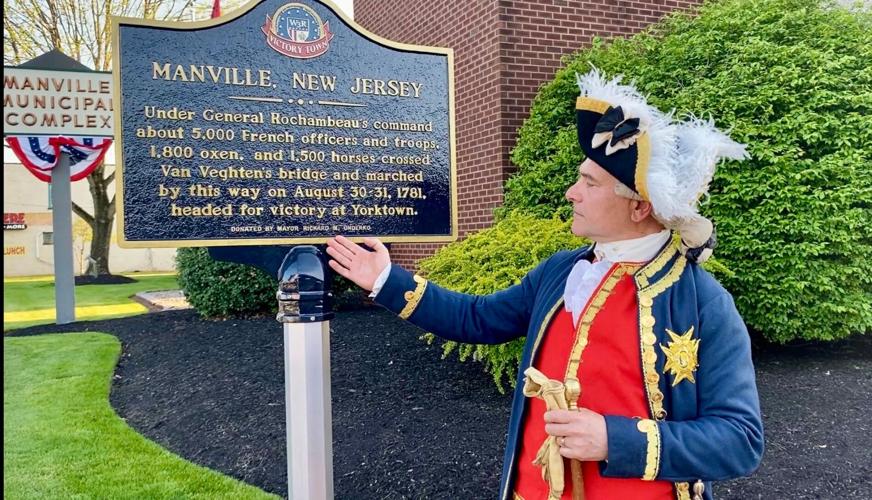
That's what the W3R's Victory Towns 250 Project, spearheaded by Fay, is all about. Historic markers are being encouraged in the towns that the troops on the "Washington Rochambeau trail" were known to have passed through.
The number of towns is high because the troops, as they moved through the state, fanned out to disguise their numbers.
The troops proceeded — by foot, by horse, by ship — to Yorktown, and to their date with fate.
And the rest, as they say, is history.

Manville "Victory 250" marker, with Eric Dutaud as Rochambeau.
Liberty enlightening the world
It's important to remember, Polyné points out, that the American Revolution didn't happen in a vacuum.
In fact, it touched off a wave of revolutionary fervor that swept the globe in the 18th century — culminating in the overthrow of the French monarchy in 1789, and the revolution in Haiti in 1791 under their own George Washington, Toussaint L'Ouverture.
And many of the Black soldiers who fought in that uprising got their training here.
Some 500 free Black troops from Saint-Domingue fought alongside the French during the 1779 Siege of Savannah — another episode in which soldiers of color played a key role. And they took what they learned back to Haiti, where they fought for, and ultimately achieved, an independent nation. The first founded by enslaved people.
"You have some of these future revolutionaries who participated in the volunteer infantry with the French, for the American side," said Polyné, whose family is from Haiti.
"What are some of the lessons they may have gotten from those early days?" he said. "That's really interesting to think about."
Coming home to what?

First Rhode Island reenactors
What, meanwhile, happened to America's Black soldiers afterwards?
Some white officers, on both sides, honored their promise of freedom. Others, on both sides, reneged and returned the enslaved to their former masters.
One notable — and notably sad — case was that of Samuel Sutphin.
"Sutphin joined up because his master said, go in my place and I'll free you after the war," Chapman said. "Sam couldn't have given a damn about liberty and British tyranny. He just knows that he'd rather not be a slave."
Alas, Sutphin didn't get it in writing.
“I believed the white man’s word, hoping to be free when the fight was over," he's said to have said. "I took no paper to show the bargain, but trusted to my master.� Between 1776 and 1778, Sutphin saw action many times, including the Battle of Long Island, was wounded in the leg, and was commended by his superior officers. "He fights, and he fights well," Chapman said.
Then he returned home to claim his promise.
Only to discover, as Supreme Court justice Roger B. Taney famously put it in 1857, that a Black man has "no rights which the white man was bound to respect."
"After the war, the master reneges on his freedom, and and he's a slave for another 20 years," Chapman said. "Which is awful."
There is, if not a happy ending, at least a kind of closure. Sutphin, after two decades, was finally able to buy his own freedom. He won a $50 annual military pension, from the State of New Jersey. And he won, Chapman said, the esteem of his neighbors. Which — for a former slave — is no small thing.
"He was respected," Chapman said. "People saw he was a veteran."

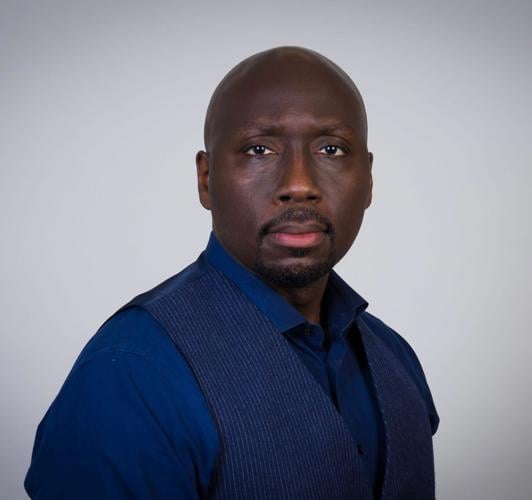
Kevin Chapman, of the First Rhode Island reenactors
Broken promises, new possibilities
The war of 1776, at the outset, had seemed to promise much.
Freedom for slaves who were willing to fight. An anti-slavery clause — later stricken — in the Declaration of Independence itself. But it wasn't enough.
The American Revolution ended in 1783. The emancipation proclamation wasn't signed into law until 1863. Eighty more years of slavery.
But there was this, too. A memory of military service — military pride — in the histories of more than a few Black families. All the brutal masters, all the injustice, in the world can't unring that bell. The Black soldiers of 1776 had fought for freedom. Their descendants would do so again.
"Freedom and liberty from tyranny means something very different to most people of color," Chapman said. "We're thinking of freedom from tyranny from you."
Does that mean that the Black soldiers of the revolution weren't patriots? By no means, Chapman said.
"Maybe some people think they're not fighting for America, but for their freedom," he said. "But freedom is America."