Arizona State University's efforts to seize a cherished Territorial-era home in downtown Phoenix for a building project that will house its new medical and engineering school is now in court.
The governing body for Arizona's public universities, on behalf of ASU, has sued Robert Young, the elderly owner of the 833-square-foot Louis Emerson House in downtown Phoenix, citing eminent domain. The Arizona Board of Regents has also named Young's renter of eight years, downtown Phoenix performance artist Barry Schwartz, as a defendant in the case. The first hearing is scheduled for June 19 in Maricopa County Superior Court
Eminent domain refers to the government's right to take possession of private property for valid public use, even if the owner objects, though the owner must receive "just" compensation. Young, an 89-year-old retired Phoenix lawyer who has owned the home since 1975 has refused all of ASU's offers to purchase it, including options to move the house. ASU's April 21, 2026, offer of $815,000 is part of the court filing.
People are also reading…
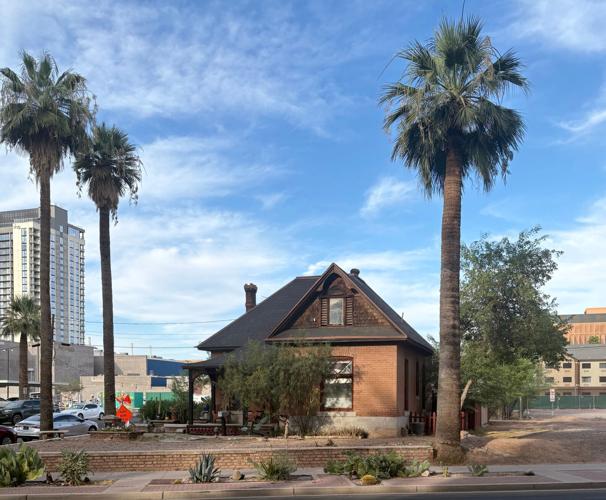
The downtown house, on the northeast corner of Pierce and North Fourth streets, was built in 1902 and sits on a lot that is 4,672 square feet, or slightly more than one-tenth of an acre, according to the Maricopa County Assessor's Office.
"What Mr. Young wants to do is keep the place, keep it there, and leave it as it's been forever," Young's attorney Francis Slavin told The Arizona Republic. "There's absolutely no reason for them to be taking this space. In fact, I think it would be rather fascinating for them to be able to say that on our downtown campus we have a 124-year-old home right on the corner."

The Louis Emerson House in downtown Phoenix was built in 1902. Arizona State University says it needs the property as part of plans to build a facility that will house its new medical school.
Similarly, Young said told The Republic he doesn't understand why ASU can't incorporate the small, brick house into its new health education building plans.
"I think it's just striking that an institutional of higher learning should be so opaque and pedestrian," Young said.
The estimated $200 million ASU Health Building will act as headquarters for a collection of health disciplines, including the ASU John Shufeldt School of Medicine and Medical Engineering, and is expected to open in 2028. The health building "is a public use authorized by law" the civil action says, and "immediate possession of the subject property (the Louis Emerson House) is necessary to prevent delay in the project and to carry out the public use."
The lawsuit says that ASU must continue negotiating with Young, even during litigation, to attempt to reach a mutual agreement as to the "just compensation for those property rights necessary for the project."
Advocate: Historic preservation is a legitimate public purpose, too
ASU officials did not respond to The Arizona Republic's questions about their efforts to forcibly take the property, including a question about whether the Louis Emerson House lot is going to be used solely for open space. ASU instead provided a written statement that says the university made "several offers" to Young to purchase the parcel, including options allowing for the house to be moved, and that Young refused all the offers.
"The university’s final offer was based on an appraisal prepared by an experienced, state-certified appraiser, a copy of which was provided to the property owner. The offers were not accepted," ASU's statement says.
The Arizona Board of Regents does not comment on pending litigation, spokesperson Megan Gilbertson wrote in a June 15 email. The regents authorized the lawsuit during its Nov. 20, 2025, board meeting "so long as final efforts to acquire the property without condemnation do not resolve the matter," board documents say.
An amended complaint filed June 1 by lawyers for the Board of Regents says the nearly 178,000-square-foot ASU Health building will have 10,400 square feet of open space if the corner lot that the Louis Emerson House is on is part of the project, and that the open space would comprise nearly 6% of the new facility. Without the Louis Emerson House and the lot it's on, the facility will have less open space: 5,678 square feet or about 3% of the project, the documents say.
"It's such a quirky situation where a state university is going to tear down an old house, ostensibly by eminent domain, for a public purpose. We would argue, and do argue, that historic preservation of a very rare architectural resource is indeed a very legitimate public purpose," said Roger Brevoort, a board member for Preserve Phoenix, a grassroots, nonprofit that advocates for historic properties and is promoting efforts to preserve the Louis Emerson House.
Brevoort characterized ASU's apparent intention to use the Emerson house and property for open space in its ASU Health building project as "ludicrous" given the home's historic importance. The house is "a tiny fraction of a corner of a site," he said.

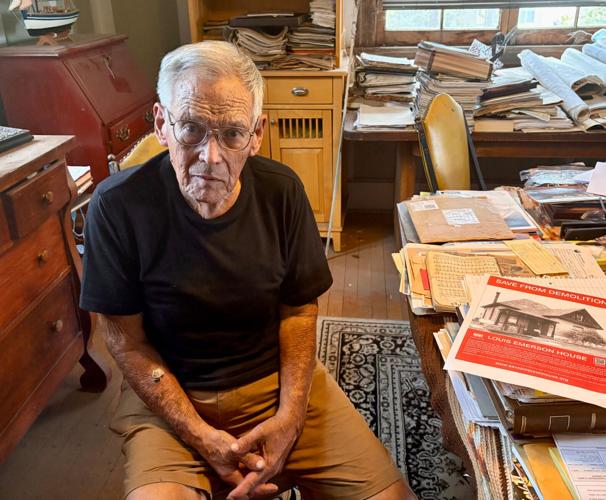
Retired attorney Robert Young has owned the historic Louis Emerson House in downtown Phoenix since 1975. He has refused Arizona State University's offers to buy it.
'I don't want it moved. It's a beautiful site'
Young told The Arizona Republic that it's impossible to provide compensation for something that's irreplaceable.
The two-story home has Victorian-era Queen Anne and Eastlake styles of architecture, but it's more modest many than other homes in that style from the turn of the 20th Century because its first owner was a working man: Louis Emerson, a Phoenix butcher who lived in the home with his family and remained until his death in the 1930s.
"It really kind of showcases what Phoenix looked like," said Marshall Shore a Phoenix historian who calls himself "Arizona's Hip Historian" and is helping Schwartz with a community-led effort to save the home. "This was an everyday man's house."
The house was already moved 44 feet east in 1990 to make room for the Arizona Center and Young, who got married on the front steps of the home in 1976, says it should stay where it is.
"I don't want it moved. It's a beautiful site," he said. "It's just gorgeous at around 5 p.m. The porch is illuminated with sunshine. ... The house has found its home and it's very happy."
Schwartz started a petition to save the house. As of June 15, the petition had collected more than 6,000 signatures and Schwartz said he's encouraged by the community support.
"We're fighting the fight as best as we can, trying to do public outreach and get people in the outlying immediate neighborhood and elsewhere to collectively come together and show that this is more than just a house. It's a historical treasure," Schwartz said.
As media coverage of the issue with the house ramped up, Schwartz has had unexpected visitors to the home and offers of help. When a reporter stopped by June 11, a woman who'd driven in from Glendale was visiting to ask how she could help save the home, and then three members of the Kuehne family from Queen Creek turned up, saying they'd heard about the issue on a far-right website called The Gateway Pundit, which framed it as an issue of government overreach.
"We need to take care of our state and historical landmarks," said Christopher Kuehne, a Marine veteran who works in a Queen Creek dairy and was pardoned by President Donald Trump after a conviction for his role in the Jan. 6, 2021, attack on the U.S. Capitol. "Medical research is important but there are always ways to think outside the box and preserve history."
Kuehne, his wife and 10-year-old son looked over information about the home that Schwartz shared. Kuehne said he's from Kansas, where people seem more respectful of history. Schwartz hugged the family before they left.
Home has been on Phoenix Historic Register since 1990
ASU has a forward-looking philosophy but building a future is not possible without acknowledging the past, Schwartz said. He pointed to a worn copy of the 2010 book "Vanishing Phoenix" by Robert Melikian that chronicles lost architectural landmarks in the city, including the downtown Fox Theater, which was built in 1931 and torn down in 1978 to make way for Phoenix's downtown bus terminal, and the Fleming Building, which was completed in 1883 and torn down nearly 100 years later.
Schwartz has turned the main front room of the Louis Emerson House into an informal museum of sorts, with historic pictures, information about old Phoenix, and a large coffee bar that he calls The Emerson Espresso Preservation Lounge. He also has what he considers to be a fortuitous thrift store find − a ball cap that says McCullough Move-A-Home, which is the name of the company that moved the home 44 feet east in 1990 − the same year the home was listed on the Phoenix Historic Property Register.
While properties on the Phoenix Historic Register are rezoned with added regulations to include a one-year pause on demolition, municipal zoning laws generally don't apply to state or federal agencies, Phoenix spokesperson Kristin Couturier wrote in an email.
Phoenix has not been directly involved in discussions regarding potential property acquisition or litigation related to the Louis Emerson House, she added.
Holding a ceremonial shovel, Phoenix Mayor Kate Gallego stood feet away from the Louis Emerson House on April 9 as she celebrated groundbreaking for the new ASU Health building along with Arizona Gov. Katie Hobbs and ASU President Michael Crow. None of the leaders at that time mentioned the gabled house that stood behind the celebratory event.
"Today is more than a groundbreaking," Gallego said that day. "It is a pivotal moment in the history of our city, our health outcomes and our job markets. Phoenix has always been a city that builds: builds opportunities, builds solutions and increasingly builds what's next."
Arizona's State Historic Preservation Office doesn't have any role in matters of eminent domain. But the office has initiated an official consultation process with ASU on the Louis Emerson House, according to Michelle Thompson, deputy assistant director of Arizona State Parks and Trails, which includes preservation office.
"They'll provide any technical advice to ensure that there's compliance with the state historic preservation act," Thompson said. "And then they'll make recommendations regarding treatments, including any alternatives to demolition."
'So much in Phoenix we've seen torn down'
When it was built, the Louis Emerson House was along the Brill Line of the old Phoenix Street Railway, which was a streetcar that ran through the city from 1888 through the 1940s.
The house now stands in stark contrast to the 21st century apartment buildings nearby, and the 30-acre Phoenix Bioscience Core, which includes vacant land slated for development by ASU. (The Bioscience Core operates on city-owned land and is a collaboration between the city, the Arizona Board of Regents, and the state's three public research universities.)
"It's one of a very small group of properties representing the earliest residential subdivisions outside the Phoenix townsite," Brevoort said, explaining that the house is in the Churchill Addition, outside the original, 320-acre Phoenix townsite.
"So much in Phoenix we've seen torn down," he said. "Let's pay attention to this and incorporate historic properties before we just willy-nilly demolish."


 The Mount Rushmore of Arizona Wildcats head coaches