

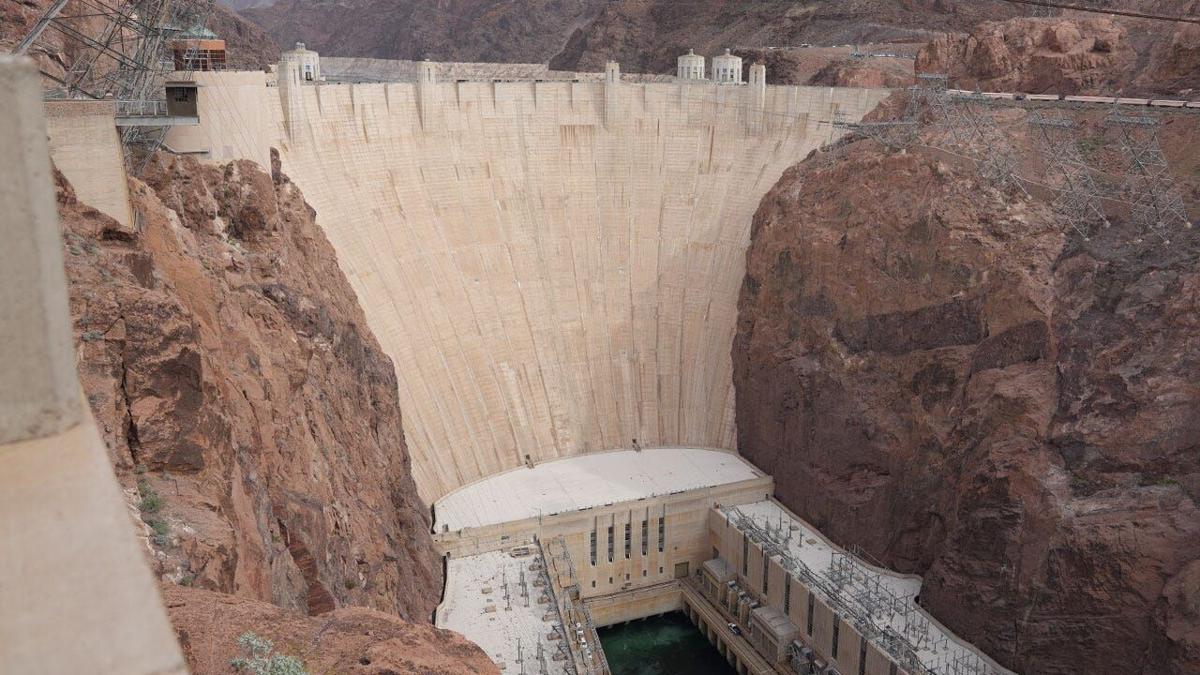
Lower water levels at Lake Mead are likely to lead to higher prices for electricity from Hoover Dam — prices high enough to make the power unaffordable to at least some of the dam's customers, a state official says.
Because the U.S. Bureau of Reclamation plans to slash flows of Colorado River water this year from Lake Powell at the Arizona-Utah boundary to Lake Mead at the Arizona-Nevada boundary, Hoover Dam's capacity to generate electricity could be reduced by up to 40% this fall. If that happens, the price of that electricity, which serves millions of people and businesses in three states, is likely to rise sharply, experts say.
Lake Mead was formed by Hoover Dam's construction in 1935, while Lake Powell was formed by Glen Canyon Dam's construction in 1963.
People are also reading…
Here are five takeaways about Hoover Dam's power generating and pricing.
- 1. After Hoover Dam was built in 1935, its electric power became much cheaper than power sold on the open market. That's because the federal government has been able to sell the power at its production costs, unlike privately generated power that's sold at a profit.
That cheap power, along with cheap water shipped from the dam to cities and farms in Arizona, Nevada and California, helped make the Southwest an attractive place to live for millions of people.
- 2. But this year, Reclamation decided it had no choice but to reduce releases to Lake Mead because otherwise, Lake Powell would fall so low that the adjoining Glen Canyon Dam couldn't generate any electricity.
- 3. At an April 20 meeting of the Arizona Power Authority, a state agency that markets Hoover Dam power to 71 Arizona customers, authority Executive Director Jordy Fuentes warned that a Hoover power cutback of that magnitude would make its power "unaffordable" to its customers.
In part, that's because the dam's generation capacity had already been cut by 30% to 35% due to previous declines in Lake Mead water levels, bringing the total power reduction from Hoover to at least 70%, Fuentes told the 51ºÚÁÏÍø.
The dam's customers include the Central Arizona Project, the Phoenix-based Salt River Project utility and dozens of cities, irrigation districts and electric districts tied to farms.
- 4. Five of Hoover's 17 turbines have already shut down due to falling water levels. The new reduction in water deliveries from Powell to Mead will knock seven more turbines out of service, Fuentes said.
Under a particularly bad scenario for Lake Mead water levels and power generation, power from Hoover Dam could cost 8 times more than it would under higher water levels and power generation, Fuentes said in an interview.
- 5. The long-term solution for Hoover Dam power is to upgrade many of its existing generators so they'll be able to generate electricity even at lower water levels, Fuentes said. About a decade ago, Reclamation upgraded five of the dam's 17 generators, which can now keep delivering power even until Lake Mead falls below 950 feet.
But the upgrades needed for the other turbines at the dam will cost lots of money, Fuentes said. The first two upgrades will be done by about 2028, and the next upgrades aren't due until 2031.
"It's not a quick fix," he said.Â
Contact Tony Davis at 520-349-0350 or tdavis@tucson.com. Follow Davis on Twitter@tonydavis987.

Tony Davis
Reporter


