
Clem Mentzer and his sister Anna lived in adjoining properties in the midtown neighborhood where they grew up.
They saw each other daily, and Anna鈥檚 sons were the closest thing Clem had to his own children.
Now one of those nephews effectively is his son, and the other is gone.
On Oct. 11, Clem Mentzer was forced to join a network of unfortunates when his sister Anna and her son Ethan were struck and killed while crossing East Pima Street to St. Cyril School. Ethan鈥檚 10-year-old brother, Eli, survived because he was home sick that day, and Clem now cares for him.
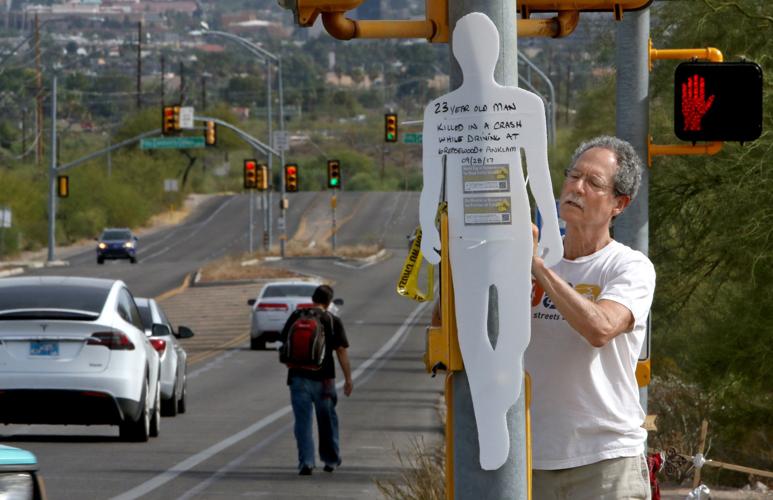
Today, Sunday, Nov. 19, the Living Streets Alliance is holding in coordination with the for Road Traffic Victims. It鈥檚 from 4:30 to 5:30 p.m. at Tucson City Hall.
People are also reading…
There is such a day, of course, because there are so many victims.
Around Tucson this week, alliance members of 57 people at the 53 sites where people have been killed by motor vehicles this year. Of those 57 victims, 28 were riding bikes or walking, and the remaining 29 were in motor vehicles themselves.
Mentzer and his nephew are two of the area鈥檚 survivors, reeling as most people do from the abrupt end of the normal lives they knew and the sudden loss of their loved ones. They鈥檙e getting by with help from St. Cyril鈥檚 and the boys鈥� godmother. But it is hard.
鈥淢y nephew and I have been trying to get through it as best as we can. He鈥檚 had a lot of support, which I鈥檓 happy about,鈥� Mentzer told me.
鈥淚 feel fortunate that I鈥檓 not emotionally paralyzed by the event,鈥� he said. 鈥淚 don鈥檛 have the time. I have to help him.鈥�
As you know if you鈥檝e kept up with or read , this has been a terrible year in Tucson for pedestrians, with 26 dying from being struck by cars, according to the Alliance鈥檚 count. But you may not have noticed bicyclists are being victimized, too, inside and outside of Tucson city limits.
I met two survivors Friday at the bicycle expo at the Tucson Convention Center that precedes El Tour de Tucson. Brendan Lyons, who is executive director of the traffic-safety group 鈥� and has twice been struck by cars while riding his bicycle 鈥� brought together Deborah Breslin and Beverly Lucke. Both of them lost their 61-year-old husbands this year.
As they told their stories, they concluded the two men, Tim Breslin and Robert Lucke, would probably have gotten along famously if they鈥檇 known each other.
鈥淭hey sound very similar,鈥� Beverly Lucke said. 鈥淭hey probably would have been cycling buddies.鈥�
Instead, Robert Lucke, who lived in Oro Valley, died under the wheels of a truck on Feb. 16 at South Sixth Avenue and 36th Street in South Tucson. A car struck Breslin near West Sahuarita Road and South La Ca帽ada Drive on Oct. 13. He died on Nov. 10 after nearly a month in the hospital.
鈥淚 always thought Tim would pull though this,鈥� Deborah Breslin said. 鈥淣ow it鈥檚 on my shoulders, and I believe I know what he wants me to do.鈥�
In the Tucson area, many people are already searching for ways to address the problem. At a Tucson Pedestrian Advisory Committee meeting Wednesday night, I heard both that this problem is not just a Tucson thing, and that it really is a Tucson thing.
It isn鈥檛 a Tucson thing in that pedestrian deaths are rising nationwide. They rose by 25 percent from 2010 to 2015, according to this year from the Governors Highway Safety Association, then they spiked by 11 percent in 2016 compared to 2015.
And yet, the problem is worse in certain places. Seattle, which has a population of about 704,000, had a total of six pedestrian deaths and two bicyclist deaths in 2016. So far this year, the city is doing a little worse, with 10 pedestrian deaths and one cyclist death. But that is, of course, much better than Tucson, population about 526,000.
Police Chief Chris Magnus told the committee Wednesday he has noticed in his jobs as a chief that local culture and enforcement simply means drivers respect pedestrians more in some places.
In his home state, Michigan, 鈥渢he car was king,鈥� Magnus said. But then he became police chief in Richmond, Calif., in the San Francisco Bay area.
There, he said, 鈥測ou stop. Pedestrians and bicyclists are on an equal footing. Moving back here (to Tucson), it鈥檚 like I鈥檓 back in Michigan again.鈥�
The Police Department has been hampered by low staffing, he said. Officers often are so backed up on higher-priority calls that they don鈥檛 have time to enforce traffic laws.
鈥淲e know that by not dealing with the traffic situation as aggressively as we鈥檇 like to, we鈥檙e going to have accidents,鈥� he said.
鈥淵ou don鈥檛 have to impress upon me the seriousness of this problem. It鈥檚 very, very significant and we鈥檝e got to get a handle on it.鈥�
But enforcement isn鈥檛 the only solution. Increasingly, groups like the Living Streets Alliance and the police are asking for help from traffic engineers to slow down traffic, improve visibility or better separate pedestrians and bicycles from motor vehicles.
鈥淓ngineering is, in some ways, the elephant in the room,鈥� Magnus said.
Tucson鈥檚 main streets are almost all designed like highways, just with lower speed limits. They give drivers an unconscious signal it鈥檚 OK to go fast. And those main streets, like the aptly named Speedway, are where the vast majority of the pedestrian deaths occur.
In Seattle, the city has begun lowering speed limits and reconfiguring roads in order to limit traffic deaths. It has a program called intended to reduce all traffic deaths to zero by 2030.
While the Living Streets Alliance has begun working on an initiative to promote 鈥渃omplete streets鈥� for Tucson, we are far from having streets that all users can share safely. In the Tucson area, we鈥檙e still in the stage of accumulating and memorializing victims, like Anna and Ethan Mentzer, Tim Breslin and Robert Lucke.