

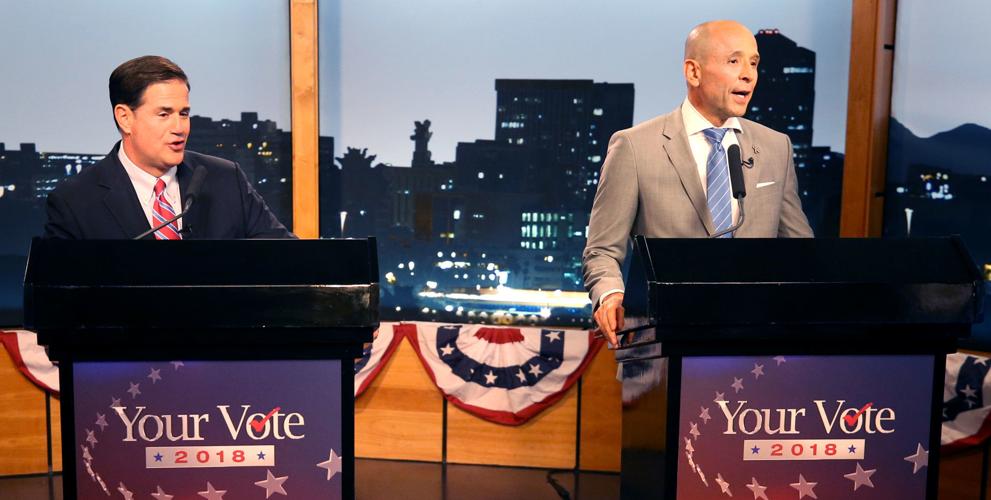
In political debates, candidates bicker, they regurgitate talking points, and the questions can be off-base.
So it was with the debates between the gubernatorial candidates this week, Monday in Phoenix and Tuesday in Tucson. But while I would have focused on some different topics, there was also enough substance for voters to chew on.
Focus on border
I was disappointed at the time spent on border-security issues in both debates. The truth is, governors play a tangential role in security at the Arizona-Mexico border.
Gov. Doug Ducey has made border security, and challenger David Garcia鈥檚 alleged weakness on immigration issues, one of the top arguments in his campaign. Garcia countered by repeating the idea that dedicating officers to the Arizona Department of Public Safety鈥檚 Border Strike Force, a Ducey initiative, has robbed some counties of 24-hour coverage by highway patrol officers.
People are also reading…
In Tuesday鈥檚 Tucson debate, Steve Goldstein, of KJZZ radio in Phoenix, asked Garcia: 鈥淵ou鈥檝e made some comments in support of replacing ICE, also opposing a border wall. If there is no wall and no enforcement of immigration in that sense, is that jeopardizing public safety of Arizona residents?鈥�
Garcia said Goldstein鈥檚 assumptions about his positions were wrong. But I鈥檇 note that the relevance of these questions is minimal in any case. ICE enforces immigration laws in the country鈥檚 interior. The border wall is a federal issue, and so is patrolling between the ports of entry.
The Border Strike Force, which the Ducey administration created with funding by the Legislature, numbers about 90 members. Yes, they have been credited with some significant seizures and arrests. But the strike force is an ant compared to the elephant that is U.S. Customs and Border Protection, the agency actually responsible for border security.
The number of U.S. Border Patrol agents in the Tucson and Yuma sectors is about 4,500. That isn鈥檛 even counting the federal inspectors at the ports of entry who catch most of the opioids that are seized on the border during smuggling efforts. In that context, the strike force and any state border-security efforts are something of a symbolic effort.
Just one water question
One of the crucial topics that went practically undiscussed, thanks in part to the border discussion, was water. Only one question was asked during the two hourlong debates about what is arguably our biggest long-term challenge.
Christopher Conover of Arizona Public Media asked, 46 minutes into the second debate: 鈥淲ater is a disappearing commodity. We live in the desert. Years ago, Tucson paid residents to get rid of their lawns, saving millions of gallons. Would you support a state law requiring the same for the rest of the state including Phoenix and Maricopa County?鈥�
It was certainly a relatable question for the majority of Arizonans who live in cities. But it really isn鈥檛 the key question on this issue. goes to irrigation for agriculture. That鈥檚 where the water is. And in most of the state, groundwater is largely unregulated and unprotected from overuse.
Agriculture and groundwater are highly sensitive issues that the candidates ought to address. Instead, Garcia answered that Ducey had failed to lead the state to a new Drought Contingency Plan, and Ducey said 鈥淎rizona is one of the best in the world at water, second only to Israel.鈥�
Garcia鈥檚 fuzzy plan
One of Ducey鈥檚 most effective attacks was to say that while Garcia talks a lot about increasing funding for education, he has no plan to pay for it. It鈥檚 an effective criticism because Garcia was counting on the Invest In Ed initiative making the ballot and acting as the main source of funding to education.
It鈥檚 not fair to say he has no plan, but he did not articulate the details well during the debate. Also, relies a lot on the Legislature taking actions that are hard to imagine, like closing tax loopholes that powerful interests have carved out for themselves.
鈥淒avid鈥檚 plan was to double income taxes in the state of Arizona,鈥� Ducey said, in an exaggeration of the financial effects the Invest In Ed initiative would have had on everyday Arizonans.
Ducey the follower
One of Garcia鈥檚 most effective critiques of Ducey is that he has been a follower, not a leader. That鈥檚 because over and over again in his first term, Ducey has reacted to an issue after seeing popular opinion consolidate around an action that he had either previously opposed or not taken an interest in.
The most obvious example is teacher pay raises. Last spring, Ducey supported only a 2 percent increase over two years. Suddenly, in the face of a massive teacher movement last April, Ducey changed and announced a plan for 20 percent pay raises over three years. Similar conversions have happened on the Prop. 301 sales tax for education, accountability measures for charter-school finance, and inspections of shelters for migrant children.
On charter-school accountability, Garcia said, 鈥淚t is only now after pressure and fear of losing your political position that you stand up to the issue.鈥� On the other hand, it鈥檚 probably a good thing for a politician to be able to adjust when an issue must be addressed.
Abortion absent
Another issue that went missing and is relevant to today鈥檚 politics: abortion and the Supreme Court nomination. If President Trump鈥檚 nominee is confirmed, it鈥檚 possible Roe vs. Wade would be overturned, or another decision would occur allowing states to restrict the right to abortion further.
If so, abortion rights and restrictions will become a major issue in the state, and where the governor stands will be crucial.
Sinema鈥檚 poverty
A few weeks ago, I found out someone had requested Kyrsten Sinema鈥檚 parents鈥� divorce file from Pima County Superior Court. I couldn鈥檛 figure out why and didn鈥檛 have the time to go through the 600-page file just to figure it out.
This week we found out: The New York Times was checking out Sinema鈥檚 oft-told story of growing up poor in Tucson and becoming essentially homeless after a move to Florida. Sinema has said that when living in an old gas-station building in Florida, they did not have running water or electricity.
The Times鈥� piece notes that the divorce file shows the family paid utility bills at the time.
The Times鈥� story says: 鈥淎sked twice whether she had ever embellished details about her childhood, Ms. Sinema paused and did not answer directly. 鈥業鈥檝e shared what I remember from my childhood. I know what I lived through.鈥� 鈥�
On the one hand, the piece seemed to reveal possible embellishments. But Sinema posted details from her life on a new web page that seemed to back up her story. And then Republicans went into overkill mode, celebrating the possibility some details of Sinema鈥檚 poor childhood were embellished with a with the mocking headline, 鈥淗elp me, I鈥檓 poor.鈥�
PAC against Adelita
The PAC opposing Tucson Unified School Board member Adelita Grijalva has put up nearly 300 roadside signs calling on voters to oust the longtime incumbent.
The PAC, No 5th Term, was started by activist Richard Hernandez, who was instrumental in recalling two Sunnyside Unified School District board members four years ago. The PAC took aim at Grijalva over a litany of complaints, including the general decline of the school district over the 16 years she鈥檚 been on the board.
The PAC still has yet to file a campaign finance report showing how much it has raised 鈥� the next round of reporting isn鈥檛 due until Oct. 15 鈥� but treasurer Pilar Ruiz said it has collected a $1,000 check from a TUSD resident, and the vast majority of its contributions have come from parents.
Grijalva had raised less than $4,000 as of the last campaign finance deadline, though last time she ran for re-election, she pulled in more than $33,000.
Star reporter Hank Stephenson contributed to this column. To contact columnist Tim Steller: tsteller@tucson.com or 807-7789.

Tim Steller
Columnist


