Elon Musk’s SpaceX is seeking a $1.75 trillion valuation in its forthcoming initial public offering. How far into the stratosphere is that?
Going by common Wall Street metrics, the answer is, way out there. SpaceX would immediately become the sixth most-valuable publicly listed U.S. firm, worth more than the likes of Meta Platforms, which has been publicly listed for more than a decade, and Berkshire Hathaway, a company older than SpaceX founder Elon Musk.

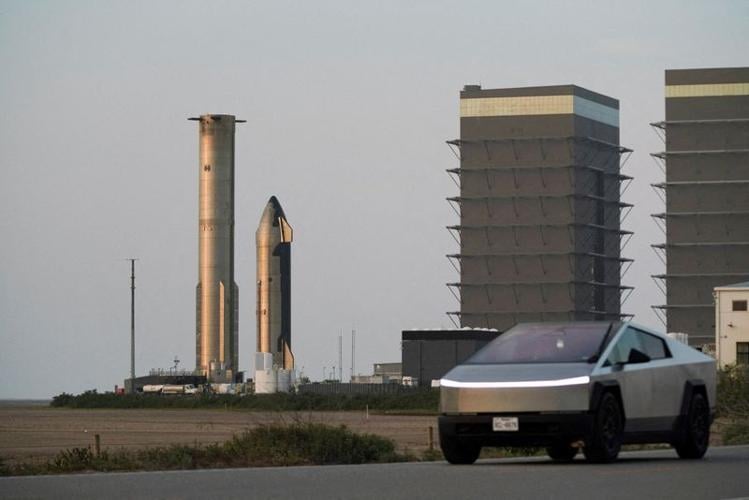
SpaceX's rocket is seen March 31 in Starbase, Texas, as the company prepares to file for an initial public offering.
And yet, there is no sign that investors will think twice about hitting the buy button once it goes public in an IPO that could raise $75 billion or more, which would be a record. The frenzy has grown so intense that some are pouring money into opaque secondary markets, accepting complex arrangements and murky ownership just for a shot at owning the shares.
"It has almost no comparable listed peer to benchmark a valuation off of and would likely come at a significant premium to anything else that is listed in the space tech sector, given its size and market leadership," said Samuel Kerr, global head of equity capital markets at Mergermarket.
People are also reading…
SpaceX's valuation is grounded in its profitable, fast-growing Starlink satellite network, which has over 10 million subscribers, and a launch business that analysts and investors say has transformed access to orbit. The Falcon 9, which in December 2015 became the first large rocket to make a controlled recovery after delivering a payload into orbit, completed 165 launches in 2025, a new annual record.

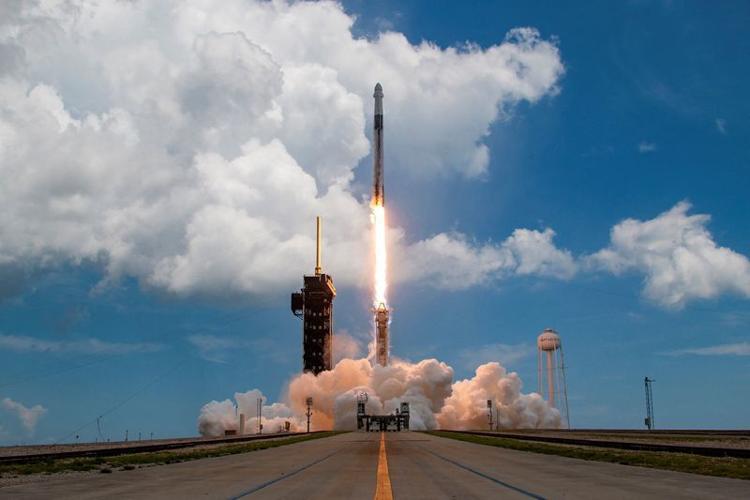
A Crew Dragon capsule atop the SpaceX Falcon 9 rocket is launched with NASA's Crew-11 mission, carrying Nigerian egusi (melon) seeds, with other seeds from other countries, at Cape Canaveral, Florida, U.S., August 1, 2025. SpaceX/Handout via REUTERS
But analysts and portfolio managers are also pricing in considerably more. Musk's track record of building successful, industry-disrupting companies gives analysts and portfolio managers confidence that the unproven bets — Starship, xAI, and an ambitious push into data-center satellites — will eventually pay off, too.
"This is a set of proven juggernaut, mega-cap businesses," said Daniel Hanson, portfolio manager at Neuberger's Quality Equity Fund, an existing SpaceX investor with close to 10% of its $2.6 billion in assets allocated to the company. "The launch business and the Starlink business are proven, here and now. xAI is about optionality," he said, referring to businesses that could add value over time as they benefit from long-term shifts toward AI, data and global connectivity.
Here’s a quick look at the pros and cons ahead of the IPO.
Leading the space race
SpaceX has a commanding lead in deploying the low-Earth orbit satellites that deliver internet and communications for its Starlink service from space. Starlink is profitable and accounts for roughly 50% to 80% of SpaceX’s revenue.
Many of the parent company’s other ambitions are yet to be realized. These include the delayed Starship rocket program for Moon and Mars missions and plans to launch up to one million data-center satellites linked to its money-losing AI unit.

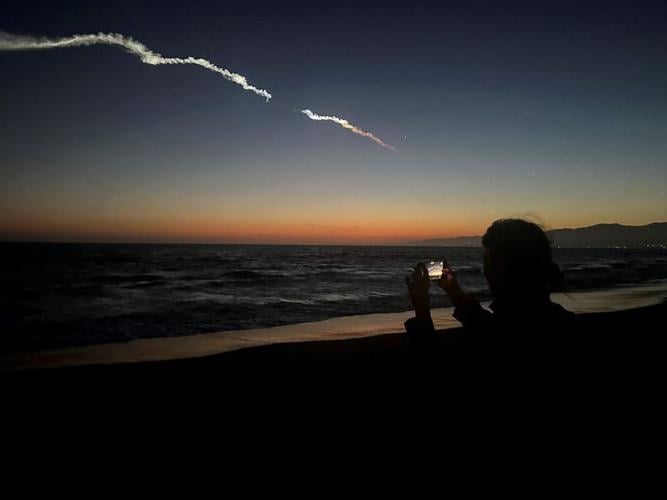
A person takes photos of a trail as the Falcon 9 carrying Starlink satellites streaks across the sky in the latest SpaceX launch as viewed from Venice Beach in Los Angeles, California, U.S., April 6, 2026. REUTERS/Daina Beth Solomon
To justify the valuation, "investors will need to keep strict tabs on the timing of Starship coming to market and on the ramp-up of Starlink service direct to cellphones," PitchBook analyst Franco Granda said in a note last month.
Even so, SpaceX launches a rocket nearly every two days, faster than any space program or firm in history, giving it key capacity in a market where launch access has become a bottleneck for rivals like Amazon, which is building its own satellite networks.
"It's a one-of-a-kind for a start," said Mark Boggett, CEO of venture capital fund Seraphim Space.
Multiples are stretched
SpaceX posted about $8 billion in profit and revenue of $15 billion to $16 billion in 2025, Reuters exclusively reported in January. The profit figure is based on EBITDA, or earnings before interest, taxes, depreciation and amortization, a standard measure of operating performance. Revenue growth has ranged in recent years from 51% in 2024 to 100% in 2021.
Unlike listed companies covered by analysts, no consensus projections exist for SpaceX's growth. Reuters made several assumptions in order to compare SpaceX's potential valuation with listed firms.
Reuters assumed cash flow and revenue would double in 2026 from reported levels in 2025, an aggressive rate aimed at making the valuation multiples err on the low side.
Using those assumptions, at a market capitalization of $1.75 trillion, SpaceX would carry a price-to-revenue multiple of 56 and a price-to-EBITDA multiple of 109, eye-popping valuations for even the fastest-growing companies.

A SpaceX Falcon 9 rocket carrying Starlink satellites streaks across the sky during a launch in California, as seen from Mexicali, Mexico, April 6, 2026. REUTERS/Victor Medina
Tesla, which Musk also leads, is valued at 12 times expected revenue and 79 times EBITDA, making it one of Wall Street's priciest stocks. Palantir is at 43 and 75 for those metrics, respectively, after its shares soared 500% in the past two years on optimism about its fast-expanding AI business.
Generally speaking, the higher the multiple, the harder it is for a company’s performance to meet expectations to keep its stock appreciating.
"Starlink is the only reason this valuation is defensible,� said Shay Boloor, chief market strategist at Futurum Equities. Its subscriber base “is just growing at crazy levels."
The fog of private company valuations
In its merger with Musk's artificial intelligence startup xAI in February, SpaceX was valued at $1 trillion and the Grok chatbot developer at $250 billion.
That transaction gives analysts at least one recent anchor for the combined entity’s value, and some investors argue it is too conservative. It is currently valued at $1.54 trillion on secondary trading venue Nasdaq Private Market.
“SpaceX is consistently one of the most actively traded names on our platform because there's nothing else like it in the private markets today," said Greg Martin, co-founder at Rainmaker Securities, a trading platform for private pre-IPO shares. “Demand has also almost always outpaced supply, and that's been true even during periods where broader secondary market activity has been more muted."
Artemis II astronauts embark on historic NASA mission as the full moon glows, in photos

Employees of the Canadian Space Agency react during the successful launch of the Artemis II moon mission, at the Canadian Space Agency, in Longueuil, Quebec, on Wednesday, April 1, 2026. (Christopher Katsarov/The Canadian Press via AP)

NASA's Artemis II moon rocket lifts off from the Kennedy Space Center's Launch Pad 39-B Wednesday, April 1, 2026, in Cape Canaveral, Fla. (AP Photo/Terry Renna)

In this photo provided by NASA, guests watch the launch of the Space Launch System (SLS) rocket and Orion spacecraft for the Artemis II mission to the moon at NASA's Kennedy Space Center in Florida on Wednesday, April 1, 2026. (Bill Ingalls/NASA via AP)

A bird flies past a full moon over Panama City, Wednesday, April 1, 2026. (AP Photo/Matias Delacroix)

NASA's Artemis II moon rocket lifts off from the Kennedy Space Center's Launch Pad 39-B Wednesday, April 1, 2026, in Cape Canaveral, Fla. (AP Photo/Chris O'Meara)

Spectators leave the A. Max Brewer Bridge after viewing NASA's Artemis II moon rocket launch, Wednesday, April 1, 2026, in Titusville, Fla. (AP Photo/Phelan M. Ebenhack)

NASA's Artemis II moon rocket lifts off from the Kennedy Space Center's Launch Pad 39-B Wednesday, April 1, 2026, in Cape Canaveral, Fla. (AP Photo/Chris O'Meara)

The full moon rises behind the statue of St. George atop of a bilding in Moscow, early Thursday, April 2, 2026. (AP Photo/Pavel Bednyakov)

Artifacts sit in the Apollo Mission Control room at Johnson Space Center on Thursday, July 24, 2025, in Houston. (AP Photo/Ashley Landis)

Photographers set up remote cameras near NASA's Artemis II moon rocket on Launch Pad 39-B just before sunrise at the Kennedy Space Center Tuesday, March 31, 2026, in Cape Canaveral, Fla. (AP Photo/Chris O'Meara)

Astronauts , from left, Mission Specialist Jeremy Hansen, of Canada, Pilot Victor Glover, Commander Reid Wiseman and Mission Specialist Christina Koch leave the Operations and Checkout Building for a trip to Launch Pad 39-B and a planned liftoff on NASA's Artemis II moon rocket at the Kennedy Space Center Wednesday, April 1, 2026, in Cape Canaveral, Fla. (AP Photo/Chris O'Meara)

Mission Commander Reid Wiseman makes a heart with his hands as he leaves the Operations and Checkout Building for a trip to Launch Pad 39-B and a planned liftoff on NASA's Artemis II moon rocket at the Kennedy Space Center Wednesday, April 1, 2026, in Cape Canaveral, Fla. (AP Photo/Chris O'Meara)

People ride a roller coaster past the full moon on the funfair in Frankfurt, Germany, Wednesday, April 1, 2026. (AP Photo/Michael Probst)

NASA emplyees react as astronauts leave the Operations and Checkout Building for a trip to Launch Pad 39-B and a planned liftoff on NASA's Artemis II moon rocket at the Kennedy Space Center Wednesday, April 1, 2026, in Cape Canaveral, Fla. (AP Photo/Chris O'Meara)

The NASA Artemis II SLS (Space Launch System) rocket with the Orion spacecraft launches at the Kennedy Space Center, Wednesday, April 1, 2026, in Cape Canaveral, Fla. (AP Photo/Chris O'Meara) CORRECTION: photographer is Chris O'Meara, not John Raoux

Members of the Cleveland Guardians warm up as NASA'S Artemis ll rocket is seen prior to launch from Launch Complex 39B at Kennedy Space Center on the big screen above them prior to a baseball game against the Los Angeles Dodgers, Wednesday, April 1, 2026, in Los Angeles. (AP Photo/Mark J. Terrill)

Ottawa city councillor Tim Tierney wears a costume astronaut helmet as he joins others watching the launch of Artemis II on a livestream displayed on the Kipnes Lantern of the National Arts Centre in Ottawa, Ontario, Wednesday, April 1, 2026. (Justin Tang/The Canadian Press via AP)

People react on Elgin Street as the Artemis II moon rocket lifts off, on a livestream displayed on the Kipnes Lantern of the National Arts Centre in Ottawa, Ontario, Wednesday, April 1, 2026. (Justin Tang/The Canadian Press via AP)

NASA's Artemis II moon rocket lifts off from the Kennedy Space Center's Launch Pad 39-B Wednesday, April 1, 2026, in Cape Canaveral, Fla. (AP Photo/John Raoux)