

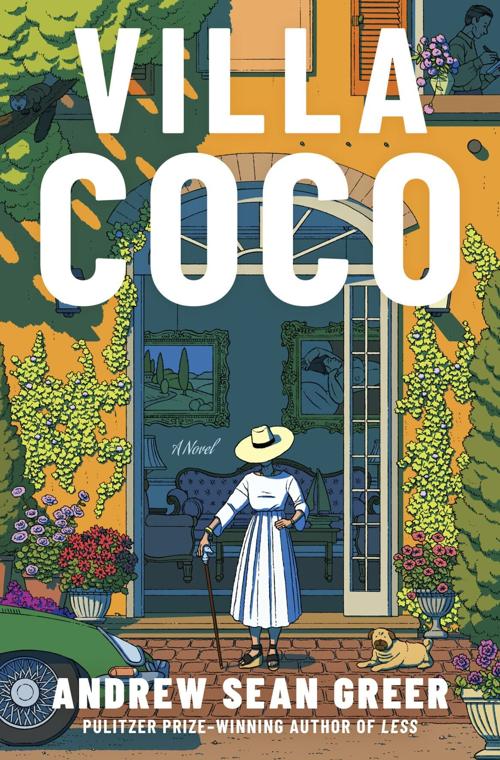
Honestly, I don’t know whether this is a review or a thank you note.
Andrew Sean Greer’s “Villa Coco†has the summery, entertaining feel of someone writing whatever he feels like writing. Greer has already won the 2018 Pulitzer Prize (for “Less,†which he followed with “â€) and has sold reams of copies of his books (don’t sleep on terrific “The Confessions of Max Tivoli,†which preceded the Pulitzer). So even his editor would have to agree that he’s earned the right to have fun.
He pledges to do just that in a note in advance copies of “Villa Coco†(it’s not included with regular copies, unfortunately). In it, he asks whatever happened to books that were created to charm — books by writers including Graham Greene and Patrick Dennis, and I’m pretty sure he’s talking about Greene’s “Travels With My Aunt†and Dennis’ “Auntie Mame.†For a more recent comparison, throw in Patrick deWitt’s aunt-less “,†which mirrors the delights of those books and then looks under the hood to find out what the delight might be hiding.
People are also reading…
“Villa Coco,†like all of those books, is full of larger-than-life characters, doing larger-than-life things and teaching larger-than-life lessons. The title house is in Tuscany, and its owner is 92-year-old Coco — whom our unnamed American narrator refers to as “the Baronessa†until the end of the book, when she becomes “my Baronessa.â€
Coco has summoned our narrator (let’s call him Joe, since the other characters call him whatever they feel like) to Tuscany to catalog her collection of treasures, which may or may not include a Picasso. Joe’s backstory is breezed through in the first few pages of “Villa Coco,†and you don’t need to remember any of it because the point is to establish that he’s an empty vessel, ready for outlandish countesses, elegant con men and sly portrait artists to fill up with crazy schemes.
There’s a heist in “Villa Coco†— of course there is — and possibly purloined jewels and inadvisable love affairs. One painting that’s been signed by the wrong artist will suggest to readers that nobody should delve too deeply into the provenance of that “Picasso.â€
It could be argued that all of this stuff is fairly low-stakes, with a bunch of rich-ish people arguing about heirlooms, but the ace up Greer’s sleeve is that the stakes are incredibly high: Joe is learning an approach to life, and the baroness and her friends are not just silly socialites but, like Auntie Mame, are humans who have experienced pain and have developed skills for dealing with it.
Throughout “Villa Coco,†Joe takes note of little bits of advice (“Every house and lover has a fatal flawâ€), bends his habits to household superstitions (“No hats on beds!â€) and chuckles at bizarre non sequiturs (â€Today we shave the dogs!“). Reading the book, you may develop a sense that the Baronessa is controlling every event, and you will be right, because she has an almost supernatural way of guiding Joe to the people he needs to meet and the things he needs to experience in order to become a creative, empathetic person.
It’s a prototypical book in which a young person benefits from the wisdom of his elders. But Greer has such a light, nimble touch — the color of a dress or the studied messiness of a room conveys a lot — that “Villa Coco†reads like a grand adventure, not a lesson.
Long story short: I have no notes, other than that I wish it were longer.
____
Villa Coco
By: Andrew Sean Greer.
Publisher: Doubleday, 266 pages.


