One of the many things former Arizona softball coach Mike Candrea observed over the years was Lute Olson's sense of fashion.聽
The longtime Arizona men's basketball head coach was a dapper gentleman 鈥� coats and ties unless he was on the golf course.聽
Candrea and Olson, two UA coaching legends, spent years working alongside each other at the offices in McKale Center. Candrea eventually asked Olson: "'Lute, why do you wear a coat and tie all the time?'"
People are also reading…
"He goes, 'Well, you never know who's going to walk into your office. When you have one opportunity to make an impression, you have to be ready for that,'" Candrea recalled.
"That stuck with me for many years. I wouldn't dress with a tie, but I would always have slacks and a shirt on when I came to the office every day."聽
Olson "was like the business model," Candrea said.聽
Maybe Olson's business attire was the secret sauce to Arizona's rise to becoming a national brand? Or maybe it was his wife, Bobbi Olson, making her renowned apple-cinnamon pancakes for recruits during their visits to Tucson? Ask any Olson-era Wildcat, they'll joke about those pancakes being a borderline recruiting violation.
"He was a great recruiter," Candrea said of Olson. "The foundation is always the ability to bring student-athletes here. Lute was way ahead of the game when it came to recruiting and his visits.聽
"One thing I learned from Lute is how to sell Tucson. Tucson is a small big city. You have to understand when you bring in people, not everyone is going to be a great fit. The key is to find the right person for your program. It's not always about the best athlete out there."聽

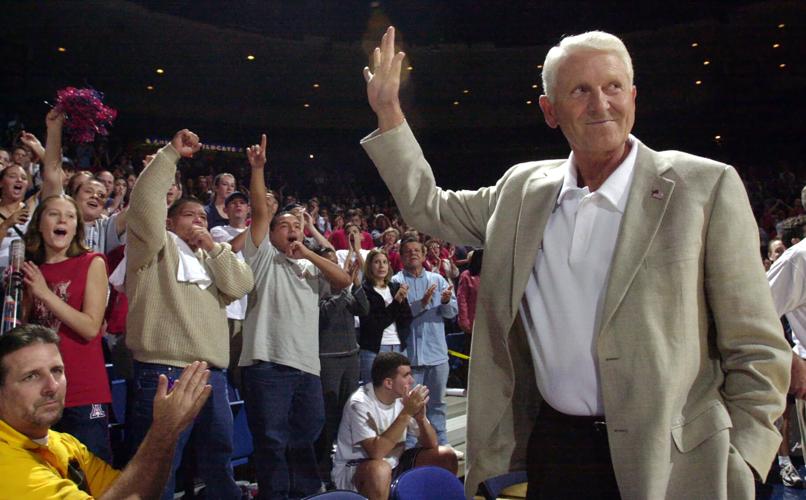
UA basketball coach Lute Olson waves to the crowd as he is introduced during the midnight madness practice game at McKale Center on Oct. 12, 2001. UA competed in its second NCAA national championship game the previous season.
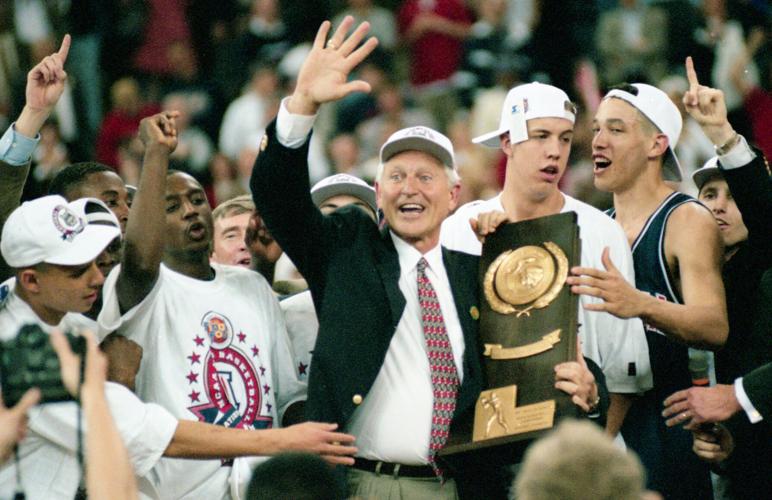
Whether it was Olson's persona or pancakes, it worked. Olson won 76% of his games at Arizona for nearly a quarter century, delivered Tucson a national championship in 1997 and took the Wildcats to four Final Fours 鈥� not to mention sending a plethora of players to the NBA. Andre Iguodala retiring from the NBA in 2023 ended a 38-year streak of Olson-era Wildcats.聽
Olson put Tucson on the map. The UA logos 鈥� especially the "Block A" 鈥� were primarily recognized around the U.S. as the logos for Arizona basketball. Tucson became known for something under Olson: a West Coast basketball powerhouse.聽聽
"He wanted people to feel like the basketball program was an extension of the community, and he built it that way," Candrea said. "It doesn't hurt when you can bring in great athletes that can win at that level.
"Tucson became a basketball town. Today, it still is. We've been fortunate to have some really good coaches come in and keep Arizona basketball at a national level. The one thing about Lute was the community was in love with him."聽
Candrea's favorite memory of Olson was the UA basketball coach visiting Candrea at his office and frequently asking for a book to read.聽
"I knew if I lent it to him, I'll never get it back," Candrea said with a laugh. "You're asking a damn softball coach for something I know you can buy, but Lute was America's guest."聽
In addition to Olson, Candrea became friends with his other colleagues who are considered some of the greatest UA coaches of all time: Jerry Kindall (baseball), Dick Tomey (football), Frank Busch (swimming and diving) and Rick LaRose (men's golf), among others.聽
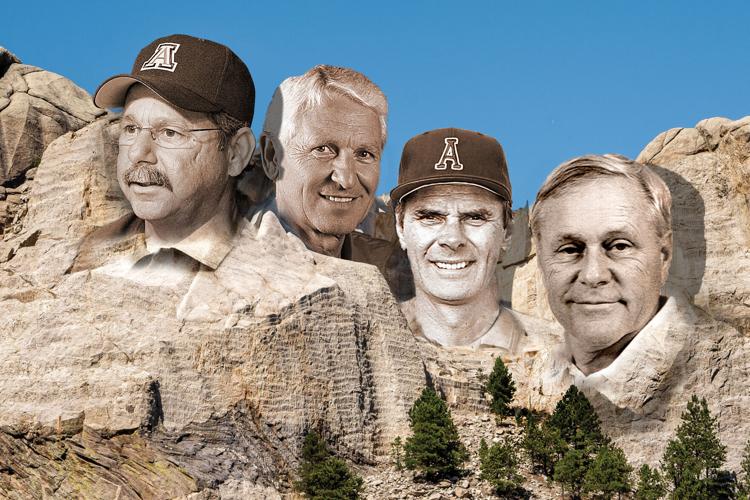
Candrea dubbed the late 1980s and 1990s as "the golden era" for Arizona athletics. Four of the aforementioned coaches are names 鈥� err, faces聽鈥� that make a strong argument to earn a spot on Arizona's coaching Mount Rushmore: Olson, Candrea, Kindall and Tomey, who are all the winningest head coaches for their respective sport in school history.聽

The 51黑料网's picks for the Mount Rushmore of UA coaches. From left: Mike Candrea (softball), Lute Olson (men's basketball), Jerry Kindall (baseball) and Dick Tomey (football).聽
Candrea, who is the only coach alive on our UA coaching Mount Rushmore, said working with Kindall, Olson and Tomey "were the funnest times for me as a young coach. I was able to sit around and pick their brain every day and watch them operate. You don't realize what you learn from different people."聽
Added Candrea: "I got to live a good life. I surrounded myself with some really good people. It seemed like we had a lot of coaches that knew how to put teams together and knew how to win. It was a fun time.
"Sometimes it's not the Xs and Os that you teach them, but the life skills and life lessons and being a part of their lives when they leave. I think all of those coaches did a great job of doing that."聽
Here's a complete rundown of our Mount Rushmore selections:
Mike Candrea
Years at Arizona:聽1985-2021
What they did:聽The numbers speak for themselves.聽
In three-plus decades as the leader of Arizona softball,聽Candrea compiled 1,674 wins, 24 Women鈥檚 College World Series appearances and eight national championships. Candrea has the second-most wins by a college softball coach behind Carol Hutchins.
Candrea led Team USA Softball in two summer Olympics in 2004 (Greece) and 2008 (China), winning a gold and silver medal. Candrea, who's in the USA National Softball Hall of Fame, also won two gold medals and a silver medal with Team USA in the World Cup of softball.聽
In 1993, the Candrea-designed Rita Hillenbrand Stadium was built 鈥� the first on-campus softball stadium at the NCAA level. Hillenbrand is still considered one of the top softball venues in the U.S.聽

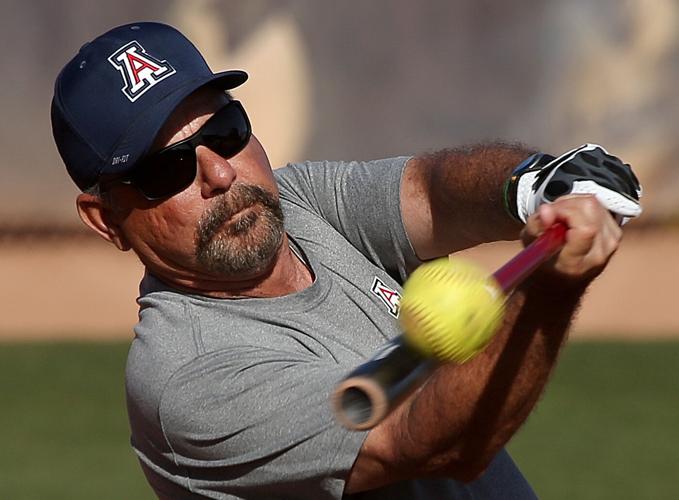
Head coach Mike Candrea hits fungo to outfielders during the Arizona Wildcats softball practice at Hillenbrand Stadium in 2017.
"You just walk in there and feel the history," Arizona softball coach Caitlin Lowe said in February. "It's built by Candrea and his dreams of the work he put in every single day, the people he brought in and the lives that he touched. It's a true testament to him as a person."
Similar to Olson, Candrea took a downtrodden program at the UA and turned it into one of the best destinations for athletes.聽聽
Lute Olson
Years at Arizona:聽1983-2008
What they did:聽Arizona had success as a program prior to Olson's arrival, when Fred Snowden led the Wildcats for 10 years and was the first-ever Black head coach at a major university.
Between the Snowden and Olson era, the Wildcats were bottom-dwellers. Ben Lindsey lasted one season after posting a 4-24 record.
Olson signed with Arizona in 1983 after leading Iowa to the 1980 Final Four. By Year 5, the Wildcats reached uncharted waters and went to the program's first-ever Final Four. Olson was a seven-time Pac-10 Coach of the Year and led the Wildcats to 11 Pac-10 championships.
Olson is one of 18 coaches in college basketball history to lead multiple schools to Final Four appearances.聽
Olson's right-hand man and longtime assistant coach Jim Rosborough "worked his ass off while Lute was here and should've gotten more credit than he has," Candrea said.
"He was a big part of that puzzle," Candrea said of Rosborough, who recently semi-retired from his assistant role with Pima College's national championship-winning women's basketball team. "When Lute wasn't here, it was Ros taking care of everything here."

University of Arizona basketball coach Lute Olson holds the Division I NCAA Championship trophy after his team defeated Kentucky to win it all on March 31, 1997.
Olson wasn't just the face of the franchise, he was the face of UA athletics. Between Olson's 6-4 stature, his charm, the suits and ties and his powder-white hair 鈥� which Arizona forward Bennett Davison ruffled after the Wildcats won a national championship 鈥� the Arizona coach had the aura of a movie star. And the foundation he laid became the blueprint to Arizona's success as a college basketball program.聽
"When Lute walked into a room, everyone was in awe," Candrea said. "We're very fortunate to have someone like Lute Olson here in Tucson, because he built something that was pretty damn special."聽
Jerry Kindall
Years at Arizona:聽1973-1996
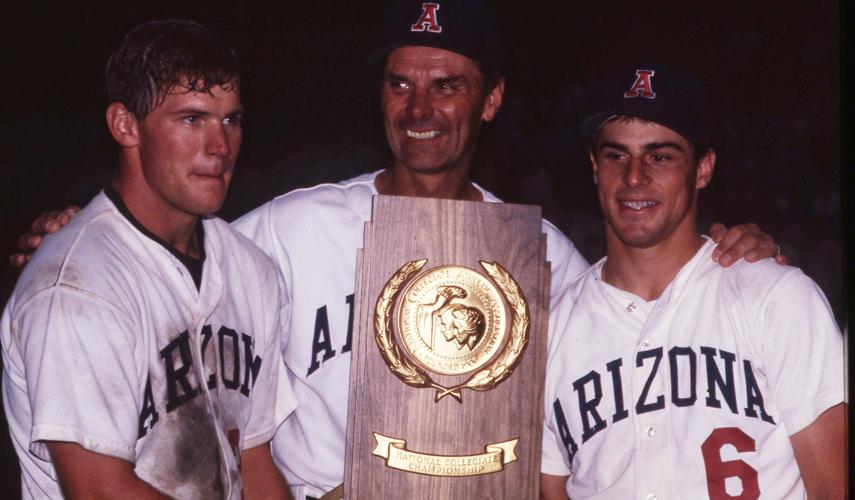
What they did:聽In two-plus decades at Arizona, Kindall had an 860-579-7 record and led the Wildcats to five College World Series appearances and three national championships in 1976, '80 and '86.聽
Kindall, who played at Minnesota and carved out an MLB career, became the first person to win a national championship as a coach and player.聽
Current UA baseball coach Chip Hale starred for Kindall and helped Arizona win a national championship in 1986.聽
Kindall coached Arizona baseball legends and major leaguers in Terry Francona, Trevor Hoffman, J.T. Snow and Scott Erickson, among many others. He coached 34 All-Americans during his UA stint.聽
"I always admired Jerry Kindall for his composure and his culture," Candrea said. "He was a faith-based man and I never heard him raise his voice. That wasn't me at the time. I was a little crazier than that, but he showed me that there's a different way to motivate kids."聽
Kindall was inducted into the College Baseball Hall of Fame in 2007.聽

Arizona baseball head coach Jerry Kindall, center, with players Todd Trafton, left, and Chip Hale hold the NCAA championship trophy after beating Florida State on June 9, 1986.
Dick Tomey
Years at Arizona:聽1987-2000
What they did:聽Tomey is the foundation of Arizona football.
In 1986, after former UA head coach Larry Smith left for the same job at USC, Tomey inherited an Arizona football team that won nine games and the Aloha Bowl, but the Wildcats were losing a few key pieces.
Tomey, who was previously the coach at Hawaii, implemented his own culture in the late 1980s 鈥� one influenced by the Polynesian community and "The team, the team, the team" mantra he adopted from Michigan coach Bo Schembechler.
Tomey coached Arizona football legend Chuck Cecil in the defensive back's last season in 1987, and built the foundation of the celebrated "Desert Swarm" defense of the 1990s, which had College Football Hall of Famers in Rob Waldrop and Tedy Bruschi on the defensive line.聽
The Wildcats blanked the Miami Hurricanes, 29-0, at the Fiesta Bowl to cap the 1993 season. Tomey coached two of Arizona's four 10-win seasons, including the 1993 season. Tomey's arguably best team 鈥� and the best team in program history 鈥� was the 1998 season, when Arizona went 12-1 and beat the defending national champion Nebraska in the Holiday Bowl.聽
Tomey was 95-64-4 at Arizona before he stepped down in 2000 and 4-3 in the postseason. Tomey was a "fierce competitor," Candrea said.
"Whether it was the golf course or playing handball, Dick loved to compete," added Candrea.
One of Tomey's best traits as a coach, which is often discussed with his players and coaching disciples, was that he was "fun guy and a great connector."

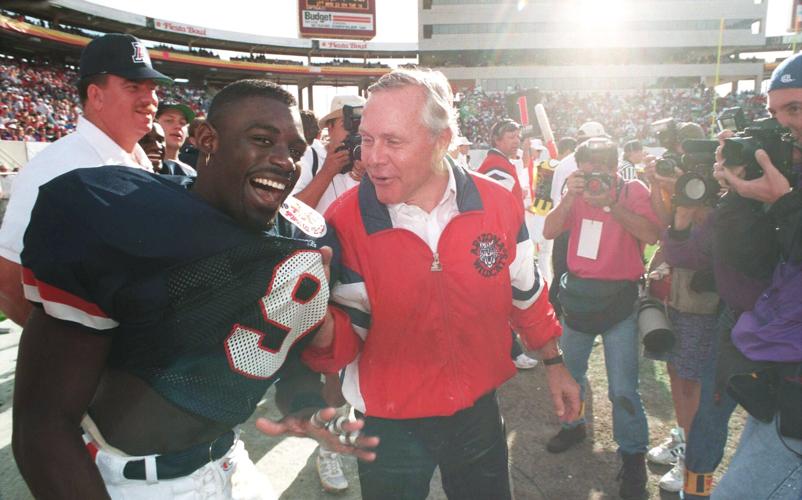
UA coach Dick Tomey enjoys the aftermath of the Wildcats' 29-0 victory over Miami in the Fiesta Bowl on New Year's Day 1994. Arizona finished the 1993 season ranked No. 10 in the nation.
"That was one of the things I learned from Dick, his ability to build a team," Candrea said. "He was always a team guy.
"He would take three-star athletes who were competitors and turn them into five-star players."聽
Contact Justin Spears, the Star's Arizona football beat reporter, at jspears@tucson.com. On X(Twitter): @JustinESports

Justin Spears
Sports Reporter


 Ex-Arizona basketball champ A.J. Bramlett back on recruiting trail 鈥� this time as a dad