

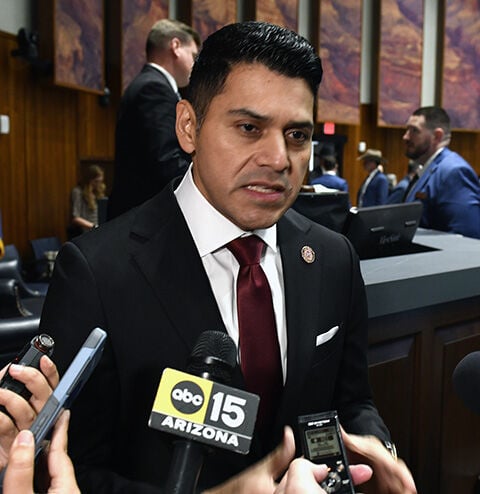
PHOENIX — House Republican leaders have agreed to impose some new limits on the use of school vouchers in Arizona in exchange for education advocate scrapping a more far-reaching measure.
The deal offered to the Arizona Education Association would most notably include putting a list into law of what kinds of purchases cannot be made with money parents receive from what are formally known as Empowerment Scholarship Accounts.
House Speaker Steve Montenegro told Capitol Media Services the union has approved the deal. A union representative would only confirm that the offer is being considered.
State law already restricts spending to what are supposed to be bona fide educational purposes, like curriculum, textbooks and even educational field trips.
But extensive reporting by KPNX has found the Department of Education has been reimbursing parents for trips to amusement parks, jewelry and even lingerie. The proposal being offered by the GOP would spell out these are clearly not allowed.
People are also reading…
House Speaker Steve Montenegro has said those reports come from "activist journalists'' and claims the reports are misleading.
But the Goodyear Republican did not deny that those stories have had an effect on public perception of the vouchers which are now funding more than 100,000 students with a $1 billion price tag.
What makes all that significant is that the Arizona Education Association and its allies are circulating petitions to put a measure on the November ballot to place even more stringent restrictions on the vouchers. It includes its own list of forbidden purchases.
Most notably, however, it would deny the vouchers, which run about $7,400 a year for students without special needs, to children in families making more than $150,000 a year. And that has been a restriction that Republicans have said is unacceptable.
Backers need to gather more than 255,000 valid signatures by July 2 to get the measure on the November ballot. And if it was approved by voters, it would be constitutionally protected against any future efforts by what has for decades been a Republican-controlled legislature to repeal it.
Under the terms of the deal being negotiated, the AEA would scrap its initiative. But here, too, Montenegro would not say that the risk of a voter-approve plan — one that lawmakers could never alter — provided a driving force for seeking a deal.
"As Republicans, we always want to look at every angle at protecting taxpayer dollars,'' he said.
"So if there is a narrative out there that provides uncertainty to the taxpayer, we're willing to address it,'' Montenegro said. "We're not afraid to address being accountable and making sure we are showing parents we will fight for them and we will also fight for taxpayer dollars to be protected.''
Initiative organizers have said they are confident they can gather sufficient signatures by the July 2 deadline. But a deal would end the need to continue to retain paid circulators.
And despite all the publicity about how voucher money is being spent — and questions about whether it takes away money from public schools — there is no guarantee that even if it made the ballot it would be enacted.
Complicating matters, another group operating under the banner of Fortify AZ is circulating its own ballot measure about vouchers. It has a similar list to the AEA proposal of forbidden purchases. But it lacks the income cap.
Having two measures on the ballot could lead to confusion and the possibility both could fail.
Montenegro said that Fortify AZ would also be part of the deal and agree to drop its own measure.
There's also something else designed to get the AEA to go along.
As part of any deal, GOP lawmakers have promised to scrap a different ballot measure of their own making that would impose new restrictions on the ability of the AEA to organize.
HCR 2040 would prohibit a school district from using public resources to support labor organizations including the use of school facilities, paid time off for union activities, and having union dues deducted from teacher paychecks. And the Senate version of the measure also would say that any organized effort by teachers to call in sick, for any reason, would result in their loss of their teaching credentials.
The GOP plan had been to put this on the November ballot. If a deal is made with the AEA, that would go away.
In offering to impose their own restrictions on vouchers, Republicans also are offering up some other changes to make it more attractive to the AEA.
One is to provide an additional $4.5 million to the Arizona Department of Education.
Rep. Matt Gress who chairs the House Education Committee said that would allow for hiring more staff to deal with parents, to help to process claims for purchases -- and to help resolve disputes if the agency tells parents that their purchases do not qualify for reimbursement. The Phoenix Republican said that is long overdue, especially with the growth of the program.
He said in 2020 there was one staffer for each 250 students in the program. Now, he said, the radio is one staffer to 4,200 students.
Much of that is a simple recognition that the program is not the same as when it was first enacted.
In 2012, vouchers were proposed to help parents of children with special needs that could not be met in public schools.
Since then there have been incremental additions, with vouchers made available groups as diverse as foster children and the children of military to those who are attending schools rated D or F.
But the real explosion came in 2022 when Republican Gov. Doug Ducey signed legislation saying any student could get a voucher. That grew the program from about 12,000 students to more than 100,000, with a $1 billion pricetag.
At least part of the reason for the sharp growth is that the change made vouchers available to students who already were in private and parochial schools with their parents picking up the tab, or they were home schooled students who now could get vouchers to pay for educational supplies.
That change also led to something else, with parents of home-schooled children taking the vouchers, spending their own money on supplies — and banking it for college.
One of the reforms offered by Republicans is to cap the amount that can be saved to no more than $24,000, with $50,000 limits for certain students with special needs. But any parent with a higher balance would be able to keep it.
Howard Fischer is a veteran journalist who has been reporting since 1970 and covering state politics and the Legislature since 1982. Follow him on X, formerly known as Twitter, , and Threads at @azcapmedia orÌýemailÌýazcapmedia@gmail.com.


